Why Study the End Times?  June 8, 2018

When I got my first ten-speed, I took it over to my Elementary School to figure out how to shift gears without fear of cars.  I was riding back and forth shifting through the gears and watching the sprockets down by my ankles.  As the ride progressed, I got increasingly focused on that front double sprocket (every ten-year old in the 70’s needed to know how to shift on the fly).     As my speed increased and my attention gaze stayed down, I ultimately ran into a light pole and messed up my front wheel and my face!  I had to push my bike home while bleeding down my shirt – a very inglorious lesson; but a lifelong one.  If my focus is ever and only on what’s going on down here; I WILL crash. God’s word tells us to look for Jesus and hope ONLY in Him – not, only, the stuff of this world (politics, job, house, $ – even family)!

We study prophecy because it gives us Hope (see verses below)!

We study prophecy to remind us that we need to Love each; other more and more as we see the day approaching (1 Peter 4:7-8).  The “Great Commandment” isn’t just a cool slogan – it’s a mandate made by God’s Son and it is our greatest need in times of trial.

Finally, we study prophecy because it reveals, in graphic detail, the fate of those that never put their trust in Jesus.  We study prophecy because it doesn’t let us half-close our eyes and pretend that our unbelieving friend isn’t going to die in her sins.  We study prophecy because it should motivate us to fulfill the Great Commission.

Praying for you all, as I know you pray for me,

Pastor Scott

“He has caused us to be born again to a living hope through the resurrection of Jesus Christ from the dead, to an inheritance that is imperishable, undefiled, and unfading, kept in heaven for you.”  —1 Peter 1:3-4

“Our citizenship is in heaven, and from it we await a Savior, the Lord Jesus Christ.”
—Philippians 3:20

“And now, O Lord, for what do I wait? My hope is in you.”  —Psalm 39:7

“Waiting for our blessed hope, the appearing of the glory of our great God and Savior Jesus Christ…” —Titus 2:13

“For this light momentary affliction is preparing for us an eternal weight of glory beyond all comparison, as we look not to the things that are seen but to the things that are unseen.” —2 Corinthians 4:17-18

“The sufferings of this present time are not worth comparing with the glory that is to be revealed to us.”  —Romans 8:18

“For whatever was written in former days was written for our instruction, that through endurance and through the encouragement of the Scriptures we might have hope.”
—Romans 15:4

“He will wipe away every tear from their eyes, and death shall be no more, neither shall there be mourning, nor crying, nor pain anymore, for the former things have passed away.”  —Revelation 21:4

“But this I call to mind, and therefore I have hope: The steadfast love of the Lord never ceases; his mercies never come to an end; they are new every morning; great is your faithfulness.”  —Lamentations 3:21-23

“Behold, I am coming soon.”  —Revelation 22:12

What if? June 1, 2018

I’m in the middle of preaching on the seven churches in Revelation.  I take the literal view that these letters were written to and about churches in the seven cities named.  The application of these passages is to evaluate our own church and, in the context of Sunday Morning, our own lives.  But what if the naming of those seven cities was just figurative and the real literal meaning was to deliver a prophecy about the church age between John’s time and ours?  It’s an intriguing thought and one held by many theologians over the years.

What if the Ephesian Church (2:1-7) represented the church at the end of the Apostolic Era, continuing to function with a certain militancy but with a receding first love?  What if the Smyrnan Church (2:8-11) is the years of Roman persecution, beginning approximately with Trajan (AD 98) and ending with the reign of Constantine (AD 313)?  What if the Pergamian Congregation (2:12-17) describes the period following Constantine’s embracing of Christianity during which the church became increasing married to the world and eventually theologically and morally apostate?  What if the church at Thyatira (2:18-29) is the church of the Middle Ages, immersed in heretical teaching and moral turpitude?  What if the Sardines (3:1-6) is the church of the Reformation when some are found who have not defiled their garments, even though the majority of the church is still dead?  What if the church at Philadelphia (3:7-13) is the church of Missionary Expansion, beginning with William Carey (1792) and continuing up to the contemporary period?  And what if the lukewarm church at Laodicea (3:14-22) is now?  What if we, individually and corporately, are one of the relatively few places people can find the cool refreshing water of love and acceptance (Great Commandment) and the hot water of truth for growing up in Christ (Great Commission)?

As widely popular and as wonderfully fitting as this view* is, it’s just speculation.  It could be exactly what the Lord Jesus wanted the Angel to communicate or it could just be a fun exercise in historical correlation, but either way our mission is the same!  We all need to return to our first love and be about His teachings; to love each other and disciple each other in His truths!

Pastor Scott

*Credit to Paige Patterson, New American Commentary on Revelation, for this summation

Am I fighting the right battle? May 22, 2018

It is said that when the British and French were fighting in Canada in the 1750s, Admiral Phipps, commander of the British fleet, was told to anchor outside Quebec. He was given orders to wait for the British land forces to arrive, then support them when they attacked the city. Phipps’ navy arrived early. As the admiral waited, he became annoyed by the statues of the saints that adorned the towers of a nearby cathedral, so he commanded his men to shoot at them with the ships’ cannons. No one knows how many rounds were fired or how many statues were knocked out, but when the land forces arrived and the signal was given to attack, the admiral was of no help. He had used up all his ammunition shooting at the “saints.”  (Clipped from Our Daily Bread)

Holy Dedication – May 18, 2018

In two days we are going to formally dedicate this new (to us) church building to the Lord.  Even though a local church’s building is NOT the temple or the wall around Jerusalem, it’s hard to not at least consider those important dedication texts.  Consider Nehemiah 8. As the post-captivity Israelites gather to celebrate the completion of the wall, Ezra unwraps the book of the Law and reads to the people.  Hearing the Law, for perhaps the first time in their lives, they begin to weep realizing how much they have grieved God by flouting His law. Not a wrong response. James tells us that there is a time to grieve our sin; Paul tells us that godly sorrow leads to repentance; and Isaiah even reminds us that Jesus will be a man of sorrows acquainted with grief.  However, Nehemiah’s response makes it clear that not even grief over something as horrific as generational idolatry has to go on forever.

Then Nehemiah, who was the governor, and Ezra the priest and scribe, and the Levites who taught the people said to all the people, “This day is holy to the Lord your God; do not mourn or weep.” For all the people were weeping when they heard the words of the Law. Then he said to them, “Go, eat of the fat, drink of the sweet, and send portions to him who has nothing prepared; for this day is holy to our Lord. Do not be grieved, for the joy of the Lord is your strength.”  ~Nehemiah 8:9-10

He is essentially reminding the wall builders, and by extension us, that as great as their sin was, the Lord was greater still.  Sorrow for sin, sorrow for loss, sorrow for unmet expectations or “unfair” life circumstances are all part of the human condition and are all evident in the lives of God’s people as recorded in His word.  But sorrow is still ultimately all about us and Nehemiah’s instruction says, “That’s not where your hope lies!” Brothers and sisters, let’s not spend our lives as a church, or as individuals, focused on what we don’t have or what we wish was true. Consider, instead, this take from a very old commentary on Nehemiah 8:10

 “‘For the joy of the Lord is your strength.’ This beautiful sentence is, literally, delight in Jehovah is a strong refuge.”  (Ellicott’s Commentary for English Readers. 1897)

Sad? Wistful? Grieved? Righteously indignant?  Don’t stay there, delight in the Lord Jehovah!

Nuff’ Said,

Pastor Scott

I never promised you a Rose Garden (5/4/18)

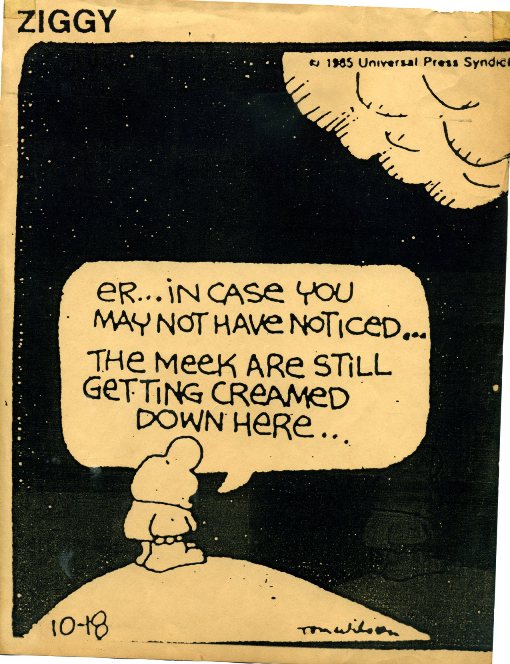
Ziggy-Meek-CartoonAnybody remember this old song?  I think it was a pop love song, not a hymn, but the line above could have easily been written by God!  Life is hard, and the Christian Life can be even harder.  Not only do we have the normal struggles with economics and physical health, but we have also been called to be holy and to have a good attitude about the struggles.   I for one would like to be happy, healthy, wealthy, wise AND hear “Well done thou good and faithful servant” when this life is done.  How about you?  Wouldn’t you like a trial free life that serves God’s purpose and keeps you smelling like a rose?

Last night in our home bible study, we were looking a Daniel 5.  There is a really interesting turn of events right before God ends, forever, the reign of Nebuchadnezzar’s family.  After Daniel reveals the meaning of the writing on the wall, “Belshazzar gave orders, and they clothed Daniel with purple and put a necklace of gold around his neck, and issued a proclamation concerning him that HE now had authority as the third ruler in the kingdom.   That same night Belshazzar the Chaldean king was slain. So Darius the Mede received the kingdom at about the age of sixty-two.”  Did you notice who got the glory?  God’s man, not God.  Contrast that with the Paul’s words in 2 Corinthians chapter four:

”If you only look at us, you might well miss the brightness. We carry this precious Message around in the unadorned clay pots of our ordinary lives. That’s to prevent anyone from confusing God’s incomparable power with us. As it is, there’s not much chance of that. You know for yourselves that we’re not much to look at. We’ve been surrounded and battered by troubles, but we’re not demoralized; we’re not sure what to do, but we know that God knows what to do; we’ve been spiritually terrorized, but God hasn’t left our side; we’ve been thrown down, but we haven’t broken. What they did to Jesus, they do to us—trial and torture, mockery and murder; what Jesus did among them, he does in us—he lives! Our lives are at constant risk for Jesus’ sake, which makes Jesus’ life all the more evident in us. While we’re going through the worst, you’re getting in on the best!”  (2 Cor 4:7-12 MSG)

Now, don’t hear me saying that God is going to forsake us (Hebrews 13:5), or that He doesn’t care (1 Peter 5:7), but do hear me say that if life isn’t going as planned, perhaps it’s because God is ensuring that He gets the Glory!  After all, nobody gets their sins forgiven and their home in heaven guaranteed, by having faith in Scott!

It’s not all about me? (April 29, 2018)

Deborah Tannen does not write as a Christian, but rather as a professional rhetorician. In her book, The Argument Culture, she recognizes the difficulty for Americans to appreciate societal benefits against a backdrop of individual rights and privileges:

“Perhaps the most fundamental [difference between American and Asian cultures] is the Western assumption that the individual self is in ongoing opposition to society. You can hear this in everyday conversations, as people talk about learning to be true to themselves by resisting society’s expectations. Donal Carbaugh listened to hours of talk on the Phil Donahue show and found that a conflict between society and the individual self was a pervasive theme running through the comments of guests and audience members. For example, one guest expressed the hope that women would learn to “make a decision all by themselves without regard to what society or somebody else says.” Society is seen as the individual’s enemy, imposing demands that conflict with actualizing your own self.”


This same spirit of individualism has crept into the Church. While God is concerned about our redemption individually, He has crafted us into a body, each uniquely possessing only a few spiritual gifts. These gifts, when joined together in ecclesiastical community, comprise the full set of abilities able to accomplish all of God’s commands. When believers view themselves only as individual entities in relationship to God, they fracture the body, handicap themselves in service, and distort the picture that Christ has painted of Himself. The Church is not about the individual person, it is about the individual Christ who saved us and has assembled us together in Him.

“For by one Spirit are we all baptized into one body, whether we be Jews or Gentiles, whether we be bond or free; and have been all made to drink into one Spirit” (1 Corinthians 12:13).

This article was posted by Shawn Nichols on a Sermon Illustrations sharing site; I don’t know if it’s original with him – but I thought it was worth re-posting.  I don’t think there is one if us who doesn’t struggle with this!  Pastor Scott


We can’t just coast! April 20, 2018

This little reminder about vigilance is special to me because I’m a big Steve Green fan and, because, my best friend from High School is a concert rigger.  This a powerful a easily remembered reminder of the Water-Walker’s words!  Steve Green tells the story of getting to know the crews who fearlessly hung speakers and lights, in event venues, from ceilings 100+ feet in the air:

Green says, “What they didn’t like, they said, were jobs in buildings that had false ceilings–acoustical tile slung just a couple of feet below the rafters. They were still high in the air, and if they slipped, their weight would smash right through the flimsy tile. But their minds seemed to play tricks on them, lulling them into carelessness.”

It’s a reminder to me that Satan’s business is not so much in scaring us to death as persuading us that the danger of a spiritual fall is minimal. No wonder Peter advised us to “resist him, standing firm in the faith” (I Peter 5:9). ~Pastor Scott

Control your tongue; stay married! April 13, 2018

Jesus famously said, “It is not what enters into the mouth that defiles the man, but what proceeds out of the mouth, this defiles the man.”  – Matthew 15:11

As I’ve been preaching on marriage and family these past few week it occurs to me that one’s self isn’t all that is defiled – whole families are brought to ruin by the tongue alone.  The “world” is even starting to notice…check out the Newsweek article:

In order to uncover the processes that destroy unions, marital researchers study couples over the course of years, and even decades, and retrace the star-crossed steps of those who have split up back to their wedding day. What they are discovering is unsettling. None of the factors one would guess might predict a couple’s durability actually does: not how in love a newlywed couple say they are; how much affection they exchange; how much they fight or what they fight about. In fact, couples who will endure and those who won’t look remarkably similar in the early days.

Yet when psychologists Cliff Notarius of Catholic University and Howard Markman of the University of Denver studied newlyweds over the first decade of marriage, they found a very subtle but telling difference at the beginning of the relationships. Among couples who would ultimately stay together, 5 out of every 100 comments made about each other were putdowns. Among couples who would later split, 10 of every 100 comments were insults. That gap magnified over the following decade, until couples heading downhill were flinging five times as many cruel and invalidating comments at each other as happy couples. “Hostile putdowns act as cancerous cells that, if unchecked, erode the relationship over time,” says Notarius, who with Markman co-authored the new book We Can Work It Out. “In the end, relentless unremitting negativity takes control and the couple can’t get through a week without major blowups.”

U.S. News & World Report, February 21, 1994, p. 67.

Thank you Lord!! April 6, 2018

Do you remember the rather silly children’s song “Arky, Arky?”  I honestly don’t remember if it’s from my childhood or from my children’s era – but since Thursday, April 5th, when we received our Permanent Certificate of Occupancy, that silly song has been running through my head!  We (BRBC/WOGF) have been in selling, packing, moving, and unpacking mode for longer than Noah and his family were on that Ark.  Yes, we weren’t suffering or witnessing what they were, but as far as I’m concerned God has caused “the sun to come out and dry up the landy, landy!”

So fellow Word of Gracers – what are waiting for?  🙂

Oh rise and shout and give God the glory, glory.
Children of the lord.