
Author: pastorscottwordofgracefellowship
On Sunday,July 14th, we had what we call a “Body Life Service” where we encourage people to to share testimonies. The focus was to be on God’s provision during the COVID-19 lock-down, yet it was inclusive of other issues as well. Yesterday I received a prayer letter from the Hughes, our Ethnos360 Missionaries serving at McNeal Air Base. It made me wish someone had transcribed our Body Life Service. In the letter Kay summarized a similar discussion she had with her ladies; be encouraged!

After 3 months of not meeting together because of COVID-19, our ladies here at McNeal had an “Elevator Time”. This is a monthly fellowship where we do a variety of things to encourage and “lift up” one another. After playing a fun game using coronavirus terms, I asked the ladies to take a few minutes to consider what the Lord has revealed to them about “themselves” or “Himself” during this time of “being still.” It was encouraging, and interesting how so many of the thoughts overlapped. Things such as:
God’s Sovereignty vs. I am not in control
God’s Protection vs. what I can do to protect myself
God’s peace vs. anxiety in the circumstances around me
God is truth vs. how can I ever know truth in all the conflicting media reports
God is our hope vs. we are not called to fight issues, but rather to share the gospel of hope with others
Though Satan should buffet, though trials should come,
Let this blest assurance control,
That Christ hath regarded my helpless estate,
And hath shed His own blood for my soul.
Because of Christ,
Pastor Scott

I had thought to write a piece this week about the brotherhood of man. I was going to start in Genesis 1 pointing out that the entire human race is related through Adam. Then my eyes fell on chapter 4 and I was quickly reminded that brotherhood doesn’t guarantee peace. The first brother murdered the second brother! It got so bad generations later that God destroyed the whole earth and started over! Still even after that, most of the atrocities in recorded history were committed between close relations until nations got big enough to form large armies.
The cool thing is that despite the fact that humans, starting with Cain, have been messing up for centuries, God has never stopped loving us. He sent Moses to redeem His people from Egypt. He sent David to unite His people in the Promised Land. He sent Jesus to redeem ALL His people and Jesus is coming again to restore justice and order once and for all.
As I said at the beginning, I had hoped to write a piece of soaring rhetoric that would offer, if not a solution, at least some new insights. However, I’m afraid I must instead come back to what, for us, seems like an old truth. Before Jesus left this earth the last time, He gathered His disciples and He said this; “A new commandment I give to you, that you love one another; as I have loved you, that you also love one another. By this all will know that you are My disciples, if you have love for one another.” (John 13:34-35 NKJV) I can hear you now – “Scott, that’s it? The streets are burning and that’s all you got?” Beloved, He died. He rose. He is coming again. He’s doing the work of redemption. He asked us to tell everybody and to LOVE! Because love is not natural. The world is all about self; love is all about others. Let’s focus on loving, and like ripples in a pond let’s affect those around us. I can’t make a difference for everyone, but I can make a difference for someone, and so can you!
Pastor Scott
Therefore if there is any consolation in Christ, if any comfort of love, if any fellowship of the Spirit, if any affection and mercy, fulfill my joy by being like-minded, having the same love, being of one accord, of one mind. Let nothing be done through selfish ambition or conceit, but in lowliness of mind let each esteem others better than himself. Let each of you look out not only for his own interests, but also for the interests of others.
Let this mind be in you which was also in Christ Jesus, who, being in the form of God, did not consider it robbery to be equal with God, but made Himself of no reputation, taking the form of a bondservant, and coming in the likeness of men. And being found in appearance as a man, He humbled Himself and became obedient to the point of death, even the death of the cross. Therefore God also has highly exalted Him and given Him the name which is above every name, that at the name of Jesus every knee should bow, of those in heaven, and of those on earth, and of those under the earth, and that every tongue should confess that Jesus Christ is Lord, to the glory of God the Father.
Pastor Scott is on vacation this week. Author Shawn Lazar wrote the following blog on June 3, 2020, via Grace Evangelical Society:
I recently turned forty-two, and just this morning, I learned that Søren Kierkegaard died at forty-two. I knew he died young, but I never took note of his age. Kierkegaard wrote numerous books and pamphlets, often under pseudonyms, writing in different “voices,” taking different points of view, writing experimentally, with some writings being enigmatically philosophical and others, often written under his own name, being explicitly Christian. And the question that people had was, “Why?”
Philosophers (especially atheist philosophers) have grown to love a “version” of Kierkegaard—i.e., Kierkegaard as an early “existentialist” or postmodern deconstructionist. But other scholars have said that misconstrues Kierkegaard’s work. What was Kierkegaard trying to achieve?
In one of his last books, My Point of View for My Work as an Author, he explained what he was doing: he was a missionary.
He thought of himself a Christian missionary to Christendom.
Kierkegaard lived at a time (the early 19th century) when all Danes were considered Christian because they were Danish! It was the state religion. You were baptized as a baby, and that became your religion. Kierkegaard went to seminary to become a pastor and realized that for most of the fellow students, being a pastor was just a profession, a way to make a middle-class living without there being a connection to a living faith.
“The apostasy from Christianity will not come about by everybody openly renouncing Christianity; no, but slyly, cunningly, by everybody assuming the name of being Christian” (Provocations, p. 232).
That’s what he saw: people calling themselves Christian who had no faith.
Given that hypocrisy, Kierkegaard could not bring himself to become a pastor. Instead, he chose to become a missionary to nominal Christians living in Christendom. He wrote religious works to build up Christians, and he wrote philosophical works to “seduce” nominal Christians into thinking more deeply about existence and perhaps lead them to God.
Although I’ve read a good deal of Kierkegaard, it has mostly been his philosophical works, not his theology. Frankly, I can’t say what Kierkegaard thought about the saving message. Did he believe in faith alone or faith plus works? I don’t know (I’ve seen quotes that could go either way). But my point is not to defend Kierkegaard’s theology. Rather, my point is, like Kierkegaard, you and I are missionaries, too, aren’t we?
After all, we live in Christendom. Is America a Christian nation? No more than was Denmark in the 19th century. Plenty of people take the name “Christian”—but are they?
We live at a time when millions of people think of themselves as Christian by default, without a real understanding, still less a real faith, in Jesus as their Messiah.
Just this week, I saw a picture of a priest “baptizing” a baby from a distance using a squirt gun (see here)! That’s Christianity and becoming Christian according to many (e.g., Catholics, Orthodox, Anglican, Lutheran, United Methodist, Presbyterian, and so on). That kind of Christendom is very, very sick.
Who is going to tell them about the promise of everlasting life? Who will disciple them to live a life pleasing to the Lord? Who is going to teach them about the hope of reigning with Christ in the kingdom?
It can’t only be pastors who are busy reaching in and caring for their flock. It will be missionaries who are reaching out—people like you and me—who can share the grace message with cultural Christians.
Kierkegaard saw the need for missionaries to cultural Christians and took it upon himself to reach out—will you?
Growing up we lived near enough to my dad’s parents to regularly have Sunday dinner with them until we moved away after my 9th grade year. When I was in 6th grade my mom (I’m being totally transparent here) started dressing me a little more stylishly. To my grandpa’s eye, those styles looked like what the Hippies wore, but he skipped right over the Hippies and called me a Communist. I had no idea what he was talking about, but I knew what a Communist was; so my response was, “Grandpa, I have two paper routes!” – which, of course, didn’t change his opinion about my plaid pants.
The moral of the story is that he never did change my opinion about the clothing (I still wore plaid for a couple more years); he changed my opinion about his opinion – about him.* I knew for a fact that plaid pants did not make me a Communist.
Sniping causes the one attacked to protect himself. Some protect themselves by hiding, some by running away, some by creating a shell. And some snipe back. In my case I tend to disregard the opinion of those who snipe. I don’t think many are changed or persuaded by sniping.
On social media the urge to snipe (argue with someone’s post)** is likely to assure that others aren’t persuaded by something we see as untrue or misleading. And I get that!! BUT when I comment under someone’s post, I am commenting to them. It’s both unkind and ineffective. If my concern is for them, I should handle the concern privately. If my concern is getting the truth out “big picture,” then I should write about the truth on my own page. I need to be as, if not MORE, polite on social media than I am in person, because on social media my audience is bigger and the record is permanent.
Walking worthy (Ephesians 4:1ff) isn’t just about what happens in church. We are the church!
Because of Grace,
Pastor Scott
*Don’t get me wrong, I didn’t hate my grandpa. I just shut him out when he opined about my hair and clothing in the early 70’s!
**While I think this has always been an issue, it seems as the political/social/covid19/racial/grief rhetoric in our country has increased so has the arguing/sniping. And it’s not how Christ would have us behave – “This you know, my beloved brethren. But everyone must be quick to hear, slow to speak and slow to anger; for the anger of man does not achieve the righteousness of God.” James 1:19-20
In Romans 14 and 1 Corinthians 8, Paul addresses an issue in the First-Century church that was causing very real division. Meat sold in the markets in those cities was apparently sold after being offered to an idol. Some church members, recognizing that idols are just man-made carvings, ate meat without any conscious thought. Others were pricked in the conscience at the thought of eating something offered to an idol (demon?). The strong meat eaters sneered at the weak abstainers. And the principled vegans judged the reckless carnivores.
Paul came down supporting the logic of the meat eaters but supporting the consciences of the vegans. He pointed out that he had the freedom to eat meat, but if he led someone to eat with him in violation of their conscience, he would be causing them to sin AND he would be sinning himself. He ends by pointing out that we have liberty, but we ought to let love regulate that liberty.
I’m watching this same type of thing play out in the world with regard to safety measures (masks, socials distancing, etc.) after two months of virus concerns.*
Populous states/counties experienced high infection/death rates and are still very focused on safety, as is the news coverage coming out of those areas, and there are myriads of stories and studies supporting a bunker mentality. They tend to be “judgy” of those who yearn to be free.
Less densely populated areas experienced fewer infections/deaths and are far more focused on getting the economy running again, as is the news coverage tailored to them, and there are a myriad of stories and studies supporting that point of view. They tend to sneer at those who appear to value safety more than freedom.
Obviously, that’s counterproductive, but that’s politics, and the country/world is only going to get more divided until The King is on The Throne. The thing is we need to NOT bring political division into the church. (1 Cor 1:10)
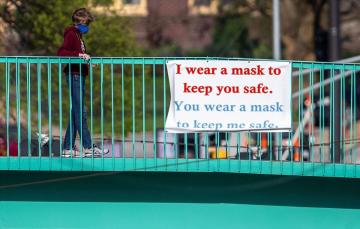
So whether you fall into the camp that believes that masks save lives or you fall into the camp that believes masks are a silly affectation, as long as the county health department asks us to wear them or not sing at all; let’s wear them and make a joyful noise unto the Lord!
Pastor Scott
*May 26, 2020
By Chris Stirewalt
A VIRUS THAT FOUND OUR POLITICAL WEAK SPOT
America is such a political basket case that even our viral infections break along partisan lines.
At least that’s how it looks when you start investigating the political geography of coronavirus. We’ve talked from the beginning how red America and blue America are having very different experiences and reactions to the pandemic and the measures taken to control it.
Now we’ve got some very useful evidence to help quantify the split.
Here’s what the NYT found: “Counties won by President Trump in 2016 have reported just 27 percent of the virus infections and 21 percent of the deaths — even though 45 percent of Americans live in these communities.”
It’s no wonder that Republicans and Democrats are talking past each other.
A plague that hits major population centers hardest is as old as plagues themselves. Population density is a dominant factor in the transmission of every communicable disease we know.
What’s different now is how well sorted politically Americans are and how little empathy partisans have for each other. With urban Republicans and rural Democrats all but extinct, there’s far less political pressure for compassion and compromise than there would have once been.
Viruses exploit the body’s weakness, so perhaps the same goes for entire nations.
Not even Paul Harvey’s “If I Were The Devil” would have a nightmare dream of something so wicked as a politically skewed virus arriving just at the moment when we’re most seriously testing the ties that bind this union: This ugly election year.
It took little imagination to know what people like that would do with a natural disaster that follows political and socioeconomic fault lines.
We have a political class that works those same levers every day. They find new and more potent ways to arouse suspicion and resentments against their fellow Americans. They happily ignore the good news when it’s better for someone else. They present every decision as good/evil, us/them, black/white. They question every motive but their own.
They do all the things that would undermine dealing effectively with the deadly virus and its economic aftermath. Cheerful cooperation and mutual respect are desperately needed in a natural disaster like this one. But those things are deadly to more than viruses; they would also kill off the brain-dead negative partisanship that passes for civic discourse these days.
The good news is that if we can summon the collective strength to deal with a virus that exploits our tribal partisanship, we will help roll back one of our leading societal ills in the process.

I watched a very thoughtful talk, from a Christian perspective, regarding how we ought not be so quick to jump aboard all of these conspiracy theories. Without going into all the details, a single point that stood out was that if one listened to more than one of them, they tended to neutralize one another. The talk counseled grace toward the decision makers in government and patient trust in God. I appreciated the wisdom and scriptural application of the presenters, but the moment they were done there were dozens of sincere “Yes, buts.”
The ones that stood out were the ones that cited such passages as the Matthew 25 admonition about not letting your lamp oil run out. The objectors reminded the presenters that we are supposed to “watch for His return” and we aren’t supposed to be caught “sleeping.” While that’s true, nowhere in scripture are we told to wring our hands wondering if this or that might be the next sign! We are told specifically to be sober, having put on the armor, to recognize we are NOT destined for wrath but for SALVATION, and to spend our time building each other up! (1 Thess 5:8-11). And even if we are being persecuted or imprisoned, the Word of God is not (2 Timothy 2:9). We can still, from wherever we are, be His ministers, His servants and His prayer warriors until He comes to take us home!
As I sat to write this week’s blog, all that came to mind was this concept of “waiting.” It feels like God has me – us – in a holding pattern as He works His will in the world. I’m sure it’s more complicated than that, and I’m sure there is much we can be doing to both improve ourselves and minister to others, but His primary message to me, and perhaps to you, is PATIENCE!! Accordingly, I went looking for an illustration and couldn’t pick just one. Enjoy! 🙂
PATIENCE
The purposes of God often develop slowly because His grand designs are never hurried. The great New England preacher Phillips Brooks was noted for his poise and quiet manner. At times, however, even he suffered moments of frustration and irritability. One day a friend saw him feverishly pacing the floor like a caged lion. “What’s the trouble, Mr. Brooks?” he asked.
“The trouble is that I’m in a hurry, but God isn’t!” Haven’t we felt the same way many times?
Some of the greatest missionaries of history devotedly spread the seed of God’s Word and yet had to wait long periods before seeing the fruit of their efforts. William Carey, for example, labored 7 years before the first Hindu convert was brought to Christ in Burma, and Adoniram Judson toiled 7 years before his faithful preaching was rewarded. In western Africa it was 14 years before one convert was received into the Christian church. In New Zealand it took 9 years, and in Tahiti it was 16 years before the first harvest of souls began.
Thomas Kempis described that kind of patience in these words: “He deserves not the name of patient who is only willing to suffer as much as he thinks proper, and for whom he pleases. The truly patient man asks (nothing) from whom he suffers, (whether) his superior, his equal, or his inferior… But from whomever, or how much, or how often wrong is done to him, he accepts it all as from the hand of God, and counts it gain!”
Our Daily Bread.
True patience is waiting without worrying.
- Swindoll, Growing Strong, p. 124.
-
“Patience serves as a protection against wrongs as clothes do against cold. For if you put on more clothes as the cold increases it will have no power to hurt you. So in like manner you must grow in patience when you meet with great wrongs, and they will then be powerless to vex your mind.”
Leonardo da Vinci.
Patience is a virtue;
Possess it if you can.
Found seldom in a woman,
Never in a man.
Source Unknown.
To those Christians who are always in a hurry, here’s some good advice from the 19th-Century preacher A.B. Simpson:
“Beloved, have you ever thought that someday you will not have anything to try you, or anyone to vex you again? There will be no opportunity in heaven to learn or to show the spirit of patience, forbearance, and longsuffering. If you are to practice these things, it must be now.” Yes, each day affords countless opportunities to learn patience. Let’s not waste them.
Commenting on our need for this virtue, M.H. Lount has said, “God’s best gifts come slowly. We could not use them if they did not. Many a man, called of God to… a work in which he is pouring out his life, is convinced that the Lord means to bring his efforts to a successful conclusion. Nevertheless, even such a confident worker grows discouraged at times and worries because results do not come as rapidly as he would desire. But growth and strength in waiting are results often greater than the end so impatiently longed for. Paul had time to realize this as he lay in prison. Moses must have asked, ‘Why?’ many times during the delays in Midian and in the wilderness. Jesus Himself experienced the discipline of delay in His silent years before His great public ministry began.”
God wants us to see results as we work for Him, but His first concern is our growth. That’s why He often withholds success until we have learned patience. The Lord teaches us this needed lesson through the blessed discipline of delay.
Our Daily Bread.
Hebrews 12:1 tells us to “run with endurance” the race set before us. George Matheson wrote, “We commonly associate patience with lying down. We think of it as the angel that guards the couch of the invalid. Yet there is a patience that I believe to be harder – the patience that can run. To lie down in the time of grief, to be quiet under the stroke of adverse fortune, implies a great strength; but I know of something that implies a strength greater still: it is the power to work under stress; to have a great weight at your heart and still run; to have a deep anguish in your spirit and still perform the daily tasks. It is a Christ-like thing! The hardest thing is that most of us are called to exercise our patience, not in the sickbed but in the street.” To wait is hard, to do it with “good courage” is harder!
Our Daily Bread
According to a traditional Hebrew story, Abraham was sitting outside his tent one evening when he saw an old man, weary from age and journey, coming toward him. Abraham rushed out, greeted him, and then invited him into his tent. There he washed the old man’s feet and gave him food and drink.
The old man immediately began eating without saying any prayer or blessing. So Abraham asked him, “Don’t you worship God?”
The old traveler replied, “I worship fire only and reverence no other god.”
When he heard this, Abraham became incensed, grabbed the old man by the shoulders, and threw him out of his tent into the cold night air.
When the old man had departed, God called to his friend Abraham and asked where the stranger was. Abraham replied, “I forced him out because he did not worship you.”
God answered, “I have suffered him these eighty years although he dishonors me. Could you not endure him one night?”
Thomas Lindberg.
When the KC Mayor began making noise about extending the stay-home order (calling it Phase #1 which is not much different from the Church’s perspective), I reached out to a contact we’d developed within the Jackson County Health Department. This person has maintained “no change” (full re-opening on May 15) all along – and then on Wednesday, May 6 the County Commissioner brought Jackson County in line with the rest of the KC Metro Area and delayed our opening, indefinitely.
I’m hopeful that we will again be able to gather some time before Fall. In the meantime lets’ keep loving each other in deed as well as word. Let’s look for ways to be a blessing. Let’s not forget to bring our full tithe into the storehouse. And let’s pray for each other and for our elected and appointed officials to strike a good balance of security and freedom. ~Pastor Scott
Do you not know? Have you not heard?
The Everlasting God, the Lord, the Creator of the ends of the earth
Does not become weary or tired.
His understanding is inscrutable.
He gives strength to the weary,
And to him who lacks might He increases power.
Though youths grow weary and tired,
And vigorous young men stumble badly,
Yet those who wait for the Lord
Will gain new strength;
They will mount up with wings like eagles,
They will run and not get tired,
They will walk and not become weary.
I am frequently asked for my opinion on what God is doing. Why a world-wide pandemic? Truth is, we may never get a satisfying answer to the big why, remember how He answered Job? God is God and God only answers to Himself. That said, because He is God, He is the Master multi-tasker; and I imagine we can each find some little (personal) whys if we just take a minute and quiet our hearts. I would also ask us each to pray that God would use this crisis to draw people everywhere closer to Himself and that He might use you and me in that process.
I really like what J.I. Packer said about how God uses these hardships:
Grace is God drawing sinners closer and closer to him. How does God in grace prosecute this purpose? Not by shielding us from assault by the work, the flesh, and the devil, nor by protecting us from burdensome and frustrating circumstance, not yet by shielding us from troubles created by our own temperament and psychology, but rather by exposing us to all these things, so as to overwhelm us with a sense of our own inadequacy, and to drive us to cling to him more closely.
This is the ultimate reason, from our standpoint, why God fills our lives with troubles and perplexities of one sort and another — it is to ensure that we shall learn to hold him fast. The reason why the Bible spends so much of its time reiterating that God is a strong rock, a firm defense, and a sure refuge and help for the weak is that God spends so much of his time showing us that we are weak, both mentally and morally, and dare not trust ourselves to find or follow the right road. When we walk along a clear road feeling fine, and someone takes our arm to help us, likely we would impatiently shake him off; but when we are caught in rough country in the dark, with a storm brewing and our strength spent, and someone takes our arm to help us, we would thankfully lean on him. And God wants us to feel that our way through life is rough and perplexing, so that we may learn to lean on him thankfully. Therefore he takes steps to drive us out of self-confidence to trust in himself, to — in the classic scriptural phrase for the secret of the godly man’s life — “wait on the Lord.”
James Packer, Your Father Loves You, Harold Shaw Publishers, 1986.