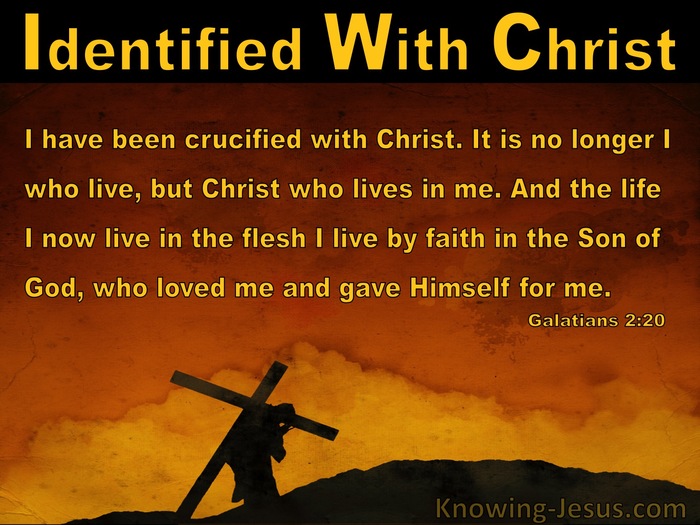
Jesus on Identity – 03.22.24

John 4 records the interaction between Jesus and the Samaritan woman at Jacob’s well.  In the first verses she is clearly identified as a “Samaritan”  – someone of a mixed race with whom Jews had little to do.  A “woman” – someone a Jewish man ought to steer clear of.  And, a “serial adulterer” that a righteous person should shun.   But Jesus, after using the I.D. to prove Who He is, blows right past that to her need for eternal life:  “but whoever drinks of the water that I will give him shall never thirst; but the water that I will give him will become in him a well of water springing up to eternal life” (John 4:14).  

Today, despite prison reform for thieves and swindlers, despite Weight Watchers and workout routines for sedentary over eaters, we live in a day where certain sinful behaviors, certain consistent temptations, are labeled as” identities;” unchangeable aspects of someone’s very nature.  When viewed with a little detachment, one can clearly see: 

a) Satan’s hand – you must accept what I do as who I am – imagine saying that to your PE teacher back in the day as he smacks the candy bar right out of your hand!

b) God’s wrath – Romans 1 says that as we suppress that worship of God and turn to the worship of creatures, He will give us over to unnatural lusts.  

That said, if you are told from the very beginning this is WHO you are, it’s no wonder that we have folks who identify themselves accordingly.

Jesus didn’t make an issue of this person’s race, gender, or sin proclivities when He offered her the Water of Life.  His concern was for her salvation.  Brothers and sisters that’s where our concern needs to be, too.  We aren’t going to beat Satan at his game in the media or by flying anti-rainbow flags.  Jesus is coming back on a white horse and He will deal with all that nonsense once and for all!

We need to love individuals and share the gospel with individuals.  If those individuals are believers struggling with this sin, then they need to be reassured that it’s just “a” sin not “the” sin.  Holiness is the goal for all of us.  We all struggle with being honest, with being faithful, with being just, with being loyal, with being pure of thought.  Their proclivity is a leaf on the tree, the root of which needs to be made holy by the blood of Jesus.

Pastor Scott

P.S.  The genesis of this blog was a rainbow flag flying in front of a church that previously seemed to have shown no such sign.   As I drove past I realized that their intention was to be loving, not to condone evil, their unseen error was believing the “identity deception.”
Reckon ye also yourselves..  03.01.24

Romans 6:1-14 reminds us that God, through the death of Christ, defanged sin in our lives.  But because we live in the flesh, walk in the world, and Satan still roams the earth we have to always be mindful of that truth (v. 11) and we have to always be intentional about not letting any part of us (Physically, mentally, emotionally, or spiritually) be used as a tool of evil (vv 12-14).   Grace freed us from the consequence of sin (Romans 4 & 5), but practical freedom from the power of sin takes some cooperation from me, because my flesh defaults toward itself.  Think about a car that pulls to the right, on a narrow windy road, filled with potholes; do I dare take my hand off the steering wheel or my eyes off the road?  Well neither should I go on cruise in my day to day life!  I need to make sure every thought is taken captive and I’m not bringing shame on His name! Amen? – Pastor Scott     

6 What shall we say then? Are we to continue in sin so that grace may increase? 2 May it never be! How shall we who died to sin still live in it? 3 Or do you not know that all of us who have been baptized into Christ Jesus have been baptized into His death? 4 Therefore we have been buried with Him through baptism into death, so that as Christ was raised from the dead through the glory of the Father, so we too might walk in newness of life. 5 For if we have become united with Him in the likeness of His death, certainly we shall also be in the likeness of His resurrection, 6 knowing this, that our old self was crucified with Him, in order that our body of sin might be done away with, so that we would no longer be slaves to sin; 7 for he who has died is freed from sin.  8 Now if we have died with Christ, we believe that we shall also live with Him, 9 knowing that Christ, having been raised from the dead, is never to die again; death no longer is master over Him. 10 For the death that He died, He died to sin once for all; but the life that He lives, He lives to God. 11 Even so consider yourselves to be dead to sin, but alive to God in Christ Jesus. 12 Therefore do not let sin reign in your mortal body so that you obey its lusts, 13 and do not go on presenting the members* of your body to sin as instruments of unrighteousness; but present yourselves to God as those alive from the dead, and your members as instruments of righteousness to God. 14 For sin shall not be master over you, for you are not under law but under grace. 

  • *“Members” [mélos] was used in antiquity of instruments of war and implements (“working parts”) of a ship. Paul used it in relation to the various functions of human personality.
(Romans 6:1-14 NASB Emphasis and * added)

Justification is Not a Process – 02.09.24

On Sunday, after a message on the Passover wherein I drew a distinction between justification and sanctification, I was stopped and asked this question in the Fellowship Hall. “Pastor, doesn’t the Bible say we have to work out our salvation with fear and trembling?”   Great question; the answer is found in the tree tenses of salvation: past, present & future;  A.K.A: Justification, Sanctification & Glorification!  

What saved us in the past, when we  were still in our sins—fallen sons of Adam by nature—was the  grace of God in the gospel. Nowhere is that put more succinctly than in Ephesians: “For by grace you have been saved through faith. And this is not your own doing; it is the gift of God, not a result of works, so that no one may boast” (Eph. 2:8–9).

But the New Testament can also speak about our salvation in the present tense—we are “being saved” (1 Cor. 1:18; 2 Cor. 2:15)—as well as in the future tense—we “shall . . . be saved” (Rom. 5:9).

There is only one salvation and one way of salvation. What occurred in our past, works itself out in the present, and comes to consummation in the future is all of a piece. Justification now leads to glorification then (Rom. 8:29–30).

Why, then, does the New Testament speak of salvation in three tenses? The answer lies in considering what happens in salvation. Initially, at the point of regeneration, our sins are forgiven — entirely and completely. We have been delivered from sin’s penalty. Through faith, we are reckoned to be righteous—as righteous as Christ is. Then, there is sanctification—a process whereby we are being delivered from sin’s power. Ultimately, in heaven, we will be delivered from sin’s presence. John Stott has argued that when Paul reasoned with Governor Felix about “righteousness and self-control and the coming judgment” (Acts 24:25), he was pointing out the three tenses of salvation.

At every stage—justification, sanctification, glorification—we come with empty hands, seeking mercy from our heavenly Father. Even at the point of our obedience as Christians—we are to “work out [our] salvation with fear and trembling” (Phil. 2:12)—we do so only because God works “in [us], both to will and to work for his good pleasure” (Phil. 2:13). And when we enter the pearly gates of heaven, wisdom will dictate that we show our empty hands and say with Edward Mote: “On Christ the solid Rock I stand; All other ground is sinking sand.”

As I mentioned on Sunday. Some will be saved “yet as through fire” (1 Cor 3:15).  A good example of those may well be Hymenaeus and Alexander who Paul turned over to Satan for the destruction of their flesh so that they might be taught not to blaspheme.  I imagine we’ll meet them in heaven, and I also imagine they will be crownless.  ☹️

Keep in mind the three tenses – it’s amazing to me how often verses like Philippians 2:12 are thrown around as if they are speaking of earning Justification.  

“….and the blood of Jesus his Son purifies us from all sin.”

Pastor Scott

P.S.  I do believe these concepts and have for a long time, but some of this verbiage is not mine.  I seem to have lost the attribution, but I don’t want to pass it off as my own.