A very relevant essay – Dec. 11, 2025

In 1954, C.S. Lewis published an essay titled “Xmas and Christmas: A Lost Chapter from Herodotus.” It is about certain winter customs of the islanders of Niatirb (Britain spelled backwards). An excerpt follows:

In the middle of winter when fogs and rains most abound they have a great festival which they call Exmas, and for fifty days they prepare for it in the fashion I shall describe. First of all, every citizen is obliged to send to each of his friends and relations a square piece of hard paper stamped with a picture, which in their speech is called an Exmas-card…And because all men must send these cards the market-place is filled with the crowd of those buying them, so that there is great labour and weariness…

They also send gifts to one another, suffering the same things about the gifts as about the cards, or even worse. For every citizen has to guess the value of the gift which every friend will send to him so that he may send one of equal value, whether he can afford it or not. And they buy as gifts for one another such things as no man ever bought for himself. For the sellers, understanding the custom, put forth all kinds of trumpery, and whatever, being useless and ridiculous, they have been unable to sell throughout the year they now sell as an Exmas gift…

This fifty days of preparation is called in their barbarian speech the Exmas Rush… But when the day of the festival comes, then most of the citizens, being exhausted with the Rush, lie in bed till noon. But in the evening they eat five times as much supper as on other days and, crowning themselves with crowns of paper, they become intoxicated. And on the day after Exmas they are very grave, being internally disordered by the supper and the drinking and reckoning how much they have spent on gifts and on the wine…

But the few among the Niatirbians have also a festival, separate and to themselves, called Crissmas, which is on the same day as Exmas. And those who keep Crissmas, doing the opposite to the majority of the Niatirbians, rise early on that day with shining faces and go before sunrise to certain temples where they partake of a sacred feast. And in most of the temples they set out images of a fair woman with a new-born Child on her knees and certain animals and shepherds adoring the Child…

But what Hecataeus says, that Exmas and Crissmas are the same, is not credible… [I]t is not likely that men, even being barbarians, should suffer so many and great things in honour of a god they do not believe in…1

As we prepare for Christmas, let us avoid being distracted by the “commercial” or “cultural” Christmas around us and focus on the one thing Christmas is really about—the Incarnation of the Son of God.

“For I have come down from heaven… to do… the will of him who sent
me… this is the will of my Father, that everyone who looks on the Son
and believes in him should have eternal life, and I will raise him up on
the last day.”

JOHN 6:38, 40 (ESV)


1 C.S. Lewis, “Xmas and Christmas: A Lost Chapter from Herodotus,” God in the Dock (Grand Rapids, MI: William B. Eerdmans Publishing Co., 1970), pp. 301-303.

Pastor Scott asking Google for Christmas quotes, totally makes Lewis’s Point:

On the Spirit & Meaning of Christmas

  • “I will honour Christmas in my heart, and try to keep it all the year”  – Charles Dickens’
  • “Christmas waves a magic wand over this world, and behold, everything is softer and more beautiful” – Norman Vincent Peale
  •  “Have Yourself a Merry Little Christmas”
  •  “The best way to spread Christmas cheer is singing loud for all to hear!”. Elf
  • “Christmas isn’t a season. It’s a feeling.” – Edna Ferber.
  • “Christmas is doing a little something extra for someone.” – Charles M. Schulz.
  • “It is Christmas in the heart that puts Christmas in the air.” – W.T. Ellis.
  • “Maybe Christmas… perhaps… means a little bit more.” – Dr. Seuss (The Grinch). 

On Love & Giving

  • “Love the giver more than the gift.” – Brigham Young.
  • “For it is in giving that we receive.” – Francis of Assisi.
  • “Gifts of time and love are surely the basic ingredients of a truly merry Christmas.” – Peg Bracken. 

Thank God for who He is – November 25, 2025

(1) Enter his gates with thanksgiving; go into his courts with praise. Give thanks to him and praise his name.
Psalm 100:4 NLT

(2) Praise the LORD! Give thanks to the LORD, for he is good! His faithful love endures forever.
Psalm 106:1 NLT

(3) “O our God, we thank you and praise your glorious name!”
1 Chronicles 29:13 NLT

(4) Let us come to him with thanksgiving. Let us sing psalms of praise to him. For the LORD is a great God, a great King above all gods.
Psalm 95:2-3 NLT

(5) Then I will praise God’s name with singing, and I will honor him with thanksgiving.
Psalm 69:30 NLT

(6) Come, let us sing to the Lord! Let us shout joyfully to the Rock of our salvation. Let us come to him with thanksgiving. Let us sing psalms of praise to him. For the Lord is a great God, a great King above all gods.
Psalm 95:1-3 NLT

(7) Give thanks to the LORD, for he is good; his love endures forever.
1 Chronicles 16:34 NIV

Praise God for what He does

(8) I will praise you, LORD, with all my heart; I will tell of all the marvelous things you have done.
Psalm 9:1 NLT

(9) But thank God! He gives us victory over sin and death through our Lord Jesus Christ.
1 Corinthians 15:57 NLT

(10) You have turned my mourning into joyful dancing. You have taken away my clothes of mourning and clothed me with joy, that I might sing praises to you and not be silent. O LORD my God, I will give you thanks forever!
Psalm 30:11-12 NLT

(11) From them will come songs of thanksgiving and the sound of rejoicing. I will add to their numbers, and they will not be decreased; I will bring them honor, and they will not be disdained.
Jeremiah 30:19 NIV

(12) The Lord is my strength and shield. I trust him with all my heart. He helps me, and my heart is filled with joy. I burst out in songs of thanksgiving.
Psalm 28:7 NLT

(13) Let the whole earth sing to the Lord! Each day proclaim the good news that he saves. Publish his glorious deeds among the nations. Tell everyone about the amazing things he does. Great is the Lord! He is most worthy of praise! He is to be feared above all gods. The gods of other nations are mere idols, but the Lord made the heavens!
1 Chronicles 16:23-26 NLT

(14) For God is the one who provides seed for the farmer and then bread to eat. In the same way, he will provide and increase your resources and then produce a great harvest of generosity in you. Yes, you will be enriched in every way so that you can always be generous. And when we take your gifts to those who need them, they will thank God.
2 Corinthians 9:10-11 NLT

(15) All of this is for your benefit. And as God’s grace reaches more and more people, there will be great thanksgiving, and God will receive more and more glory.
2 Corinthians 4:15 NLT

(16) Let them give thanks to the Lord for his unfailing love and his wonderful deeds for mankind, for he satisfies the thirsty and fills the hungry with good things.
Psalm 107:8-9 NIV

(17) “We give thanks to you, Lord God Almighty, the One who is and who was, because you have taken your great power and have begun to reign.”
Revelation 11:17 NIV

(18) Every good and perfect gift is from above, coming down from the Father of the heavenly lights, who does not change like shifting shadows.
James 1:17 NIV

Be grateful for the faith-filled changes God makes in you

(19) And now, just as you accepted Christ Jesus as your Lord, you must continue to follow him. Let your roots grow down into him, and let your lives be built on him. Then your faith will grow strong in the truth you were taught, and you will overflow with thankfulness.
Colossians 2:6-7 NLT

(20) Make thankfulness your sacrifice to God, and keep the vows you made to the Most High.
Psalm 50:14 NLT

(21) Let the message about Christ, in all its richness, fill your lives. Teach and counsel each other with all the wisdom he gives. Sing psalms and hymns and spiritual songs to God with thankful hearts. And whatever you do or say, do it as a representative of the Lord Jesus, giving thanks through him to God the Father.
Colossians 3:16-17 NLT

(22) And let the peace that comes from Christ rule in your hearts. For as members of one body you are called to live in peace. And always be thankful.
Colossians 3:15 NLT

(23) Rejoice always, pray continually, give thanks in all circumstances; for this is God’s will for you in Christ Jesus.
1 Thessalonians 5:16-18 NIV

(24) Don’t worry about anything; instead, pray about everything. Tell God what you need, and thank him for all he has done. Then you will experience God’s peace, which exceeds anything we can understand. His peace will guard your hearts and minds as you live in Christ Jesus.
Philippians 4:6-7 NLT

(25) Therefore, since we are receiving a kingdom that cannot be shaken, let us be thankful, and so worship God acceptably with reverence and awe, for our “God is a consuming fire.”
Hebrews 12:28-29 NIV

(26) I always thank my God for you and for the gracious gifts he has given you, now that you belong to Christ Jesus.
1 Cor 1:4 NLT

(27) Since everything God created is good, we should not reject any of it but receive it with thanks. For we know it is made acceptable by the word of God and prayer.
1 Timothy 4:4-5 NLT

(28) But thank God! He has made us his captives and continues to lead us along in Christ’s triumphal procession. Now he uses us to spread the knowledge of Christ everywhere, like a sweet perfume.
2 Corinthians 2:14 NLT

(29) But I will offer sacrifices to you with songs of praise, and I will fulfill all my vows. For my salvation comes from the LORD alone.
Jonah 2:9 NLT

(30) In that wonderful day you will sing: “Thank the LORD! Praise his name! Tell the nations what he has done. Let them know how mighty he is!
Isaiah 12:4 NLT

(31) Devote yourselves to prayer with an alert mind and a thankful heart.
Colossians 4:2 NLT

(32) In God, whose word I praise— in God I trust and am not afraid. What can mere mortals do to me?
Psalm 56:4 NIV

(33) Through Jesus, therefore, let us continually offer to God a sacrifice of praise—the fruit of lips that openly profess his name.
Hebrews 13:15 NIV

(34) I will sing of the Lord’s unfailing love forever! Young and old will hear of your faithfulness. Your unfailing love will last forever. Your faithfulness is as enduring as the heavens.
Psalm 89:1-2 NLT

(35) Finally, brothers and sisters, whatever is true, whatever is noble, whatever is right, whatever is pure, whatever is lovely, whatever is admirable—if anything is excellent or praiseworthy—think about such things.
Philippians 4:8 NIV

Just a Thought – Happy Thanksgiving!

Pastor Scott

Duplicate Fruits?  Nov 20, 2025

Sunday (11/16),  when preaching on James 3, I mentioned the Greek word prautés (v. 17), which is translated “gentleness” in NASB, which I think of as “meekness.”  I then received a question on our text line about Galatians 5:22-23, in which meekness and gentleness are used separately, at least in the  KJV.* 

As I understand it, prautés is strength under control (see below).  Think of a gentle elephant.  He could rip me in half, but he controls his strength and behaves “gently” toward me.  The other is chréstotés, often translated as “kindness” (but gentleness in KJV – also below) it is best thought of as “useful action.”   So the short answer is that the fruits don’t overlap in Greek, but with almost 600 years of various English translations they certainly seem to!  Another example of that is “patience and endurance.”  The old word for ”patience” was “longsuffering” and the old word for “endurance” was “patience.”

prautés: Gentleness; meekness

Original Word: πραΰτης
Part of Speech: Noun, Feminine
Transliteration: prautés
Pronunciation: prah-oo’-tace
Phonetic Spelling: (prah-oo’-tace)
KJV: meekness
NASB: gentleness, consideration, humility, meekness
Word Origin: [from G4239 (πραΰς – Meek)]

1. mildness
2. (by implication) humility

chréstotés: Kindness, goodness, gentleness

Original Word: χρηστότης
Part of Speech: Noun, Feminine
Transliteration: chréstotés
Pronunciation: khray-stot’-ace
Phonetic Spelling: (khray-stot’-ace)
KJV: gentleness, good(-ness), kindness
NASB: kindness, good
Word Origin: [from G5543 (χρηστός – good)]

1. usefulness, i.e. morally, excellence (in character or demeanor)

This is just a good example of Godly traits that are also fruits of the Spirit.  We should be working to cultivate all of these qualities in our daily lives.  It’s one thing to have a meek (gentle) response when someone “comes at us” it’s another thing to act kindly (gently) by serving others where there is a need!

Hope that’s helpful,

Pastor Scott

*Most of our Bible Language Tools are tied to King James

Eternity: Where Your Heart Lives – Nov 6, 2025

The words of Jesus, recorded in Matthew 6:19-21, provide us with a timeless and radical financial philosophy. It is an invitation to examine our priorities, not just our budgets, and to determine the true value of our investments. “Do not lay up for yourselves treasures on earth,” the scripture instructs, “where moth and rust destroy and where thieves break in and steal, but lay up for yourselves treasures in heaven, where neither moth nor rust destroys and where thieves do not break in and steal. For where your treasure is, there your heart will be also.”

This passage is a clear-eyed statement on the inherent risk of material wealth. The concepts of moth, rust, and thieves are universal symbols of loss and entropy. Moths speak of decay—the finest fabric eventually unravels. Rust speaks of corrosion—the strongest metal eventually fails. Thieves speak of sudden, uncontrollable external loss. In our modern age, these symbols translate to depreciation, obsolescence, market crashes, and the inevitable passage of time that renders our physical possessions irrelevant. To anchor our deepest sense of security and identity in things that are fundamentally temporary is, ultimately, to set ourselves up for disappointment. It is an investment guaranteed to fail.

The counter-directive, however, offers an exciting alternative: “lay up for yourselves treasures in heaven.” This is not a call to literal poverty, but a powerful call to reallocate our most precious resources—our time, energy, attention, and compassion—toward things that cannot be destroyed.

What are heavenly treasures? They are not possessions but contributions. They are the character we build through integrity, the love we give through service, the wisdom we gain through patience, and the faith we demonstrate through action. These are the “assets” that grow stronger under pressure, cannot be stolen, and transcend our lifetime. The kindness you show to a stranger, the forgiveness you grant to an offender, the effort you put into developing a skill that serves others—these are the investments that accrue eternal returns.

The final verse serves as the absolute hinge of the passage: “For where your treasure is, there your heart will be also.”

This is the psychological and spiritual truth at the core of the teaching. Our heart—our emotional center, our focus, our peace, and our anxiety—is not an independent entity. It is a satellite that orbits whatever we deem most valuable. If we spend 90% of our daily thought worrying about accumulating, protecting, and maintaining earthly things, our hearts will be tethered to fear, scarcity, and the volatility of the material world. We will feel rich one day and poor the next.

But if we deliberately choose to make heavenly virtues and lasting relationships our primary investment, our hearts will find a home in a place of profound and unshakable security. When our treasure is permanent, our peace becomes permanent. This choice liberates us from the treadmill of consumerism and connects us to a purpose that is truly immortal.

Let us be wise investors. Let us re-examine how we spend the limited currency of our lives. The greatest risk is not in having too little, but in treasuring the wrong things. Today, choose to invest in the eternal, and watch your heart settle into a place of enduring freedom.

Pastor Scott

P.S. This piece came up when I was trying to Google the verses (Matt 6:19-21); it’s without attribution but rings true! Hope it’s thought provoking!

Molech: The Idol of Fire and Fear – October 23, 2025

For centuries, the name Molech has echoed through Scripture and history as a symbol of terror and corrupted worship. The Bible presents Molech not as myth, but as a very real deity venerated by the Canaanites and later imitated by some Israelites who fell into apostasy. His worship represents one of the darkest chapters in Israel’s spiritual history—a chilling example of what happens when God’s people abandon His truth for the practices of surrounding nations.

In the Old Testament, God explicitly forbade Israel from participating in Molech worship. “Do not give any of your children to be sacrificed to Molech, for you must not profane the name of your God. I am the LORD” (Leviticus 18:21). Yet despite these commands, several kings of Judah defied God and reintroduced these abominations. King Ahaz “burned his son as an offering” (2 Kings 16:3), and later, King Manasseh “sacrificed his own son in the fire” (2 Kings 21:6). These horrific acts took place in the Valley of Ben Hinnom—known as Topheth—just outside Jerusalem’s walls.

The prophet Jeremiah condemned this valley as a place of judgment:

“They built high places for Baal in the Valley of Ben Hinnom to sacrifice their sons and daughters to Molech, though I never commanded—nor did it enter my mind—that they should do such a detestable thing” (Jeremiah 32:35). Because of this, the valley became a symbol of divine wrath and eternal punishment. In later Jewish and Christian thought, Gehenna (derived from Geh Hinnom) became synonymous with hell itself.

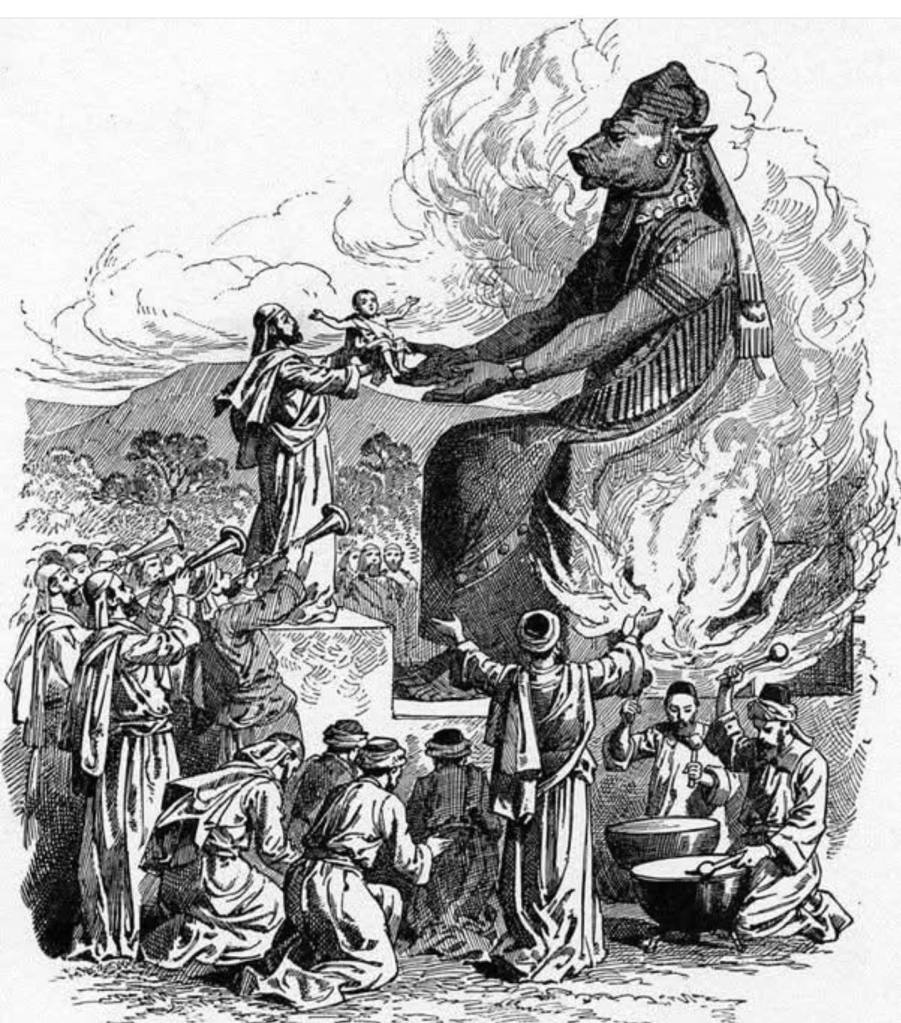
Outside the Bible, ancient sources provide eerie confirmation of such practices. Greek historians like Diodorus Siculus (1st century BC) and Plutarch described Phoenician and Carthaginian rituals in which children were offered to a god they equated with Cronus—a deity closely identified with the Canaanite Molech. According to their accounts, a bronze statue—human-shaped but crowned with a bull’s head—was heated from below until its metal glowed red, and the victims were placed into its blazing arms while drums beat to muffle their screams.

Archaeological excavations at Carthage, Rabat, and other Phoenician colonies have uncovered Tophet cemeteries containing urns filled with the cremated remains of infants and animals. While scholars debate whether all such offerings were true sacrifices or vows made during times of distress, the evidence unmistakably points to widespread ritual burning of children—a horrifying practice that mirrors the biblical description of Molech worship in the Canaanite world.

In Israel, the prophets condemned these acts as both moral and spiritual rebellion. They represented a complete inversion of God’s commands—offering life, the most sacred gift, to a false god of death. King Josiah, in his reforms, finally desecrated Topheth to put an end to these practices (2 Kings 23:10), symbolically reclaiming the land from darkness.

Molech’s image—part history, part warning—embodies the tragic pattern of idolatry: humanity’s attempt to appease false gods through destruction. The fires of Molech may have burned out long ago, but his legacy endures as a lesson written in both Scripture and stone. He stands as a symbol of what happens when devotion divorces itself from truth—when man worships power, fear, or self in the place of the living God.

Today, Molech’s name is remembered not as one of honor, but as a haunting reminder of how far people can fall when they reject the Creator. His story calls believers to remain steadfast in the worship of the one true God, whose commands protect life and whose fire purifies rather than destroys.

NOTE FROM PASTOR SCOTT – I had a blog about “social issues” ready to go for today. In it I referenced this particular demon; and this morning this article posted to my feed. Thought it was too good not to share!

JOY DOWN IN MY HEART – 10.16.2025

This version was written after I was already an adult; but these verses go back to my childhood.  The song may seem juvenile or even vapid, but in a very down to earth way they contain deep truth.  If we don’t have a reservoir of joy, peace and love deep in our hearts – then we actually need to let go of our very adult concerns and turn our eyes upon Jesus!

Sing with me!

I’ve got that joy joy joy joy down in my heart –Where?

Down in my heart –Where?

Down in my heart –Where?

I’ve got that joy joy joy joy down in my heart –Where?

Down in my heart to stay

I’ve got that joy joy joy joy down in my heart –Where?

Down in my heart –Where?

Down in my heart –Where?

I’ve got that joy joy joy joy down in my heart –Where?

Down in my heart to stay

I’ve got the peace that passes understanding down in my heart –Where?

Down in my heart –Where?

Down in my heart –Where?

I’ve got the peace that passes understanding down in my heart –Where?

Down in my heart to stay

CHORUS

And I’m so happy, so very happy

I’ve got the love of Jesus in my heart

And I’m so happy, so very happy

I’ve got the love of Jesus in my heart

I’ve got the love of Jesus down in my heart –Where?

Down in my heart –Where?

Down in my heart –Where?

I’ve got the love of Jesus down in my heart –Where?

Down in my heart to stay

Joy joy joy joy joy joy joy joy joy jo-o-o-oy

Joy jo-o-o-o-oy

I’ve got that joy joy joy joy down in my heart –Where?

Down in my heart –Where?

Down in my heart –Where?

I’ve got that joy joy joy joy down in my heart –Where?

Down in my heart to stay

CHORUS

And I’m so happy, so very happy

I’ve got the love of Jesus in my heart

And I’m so happy, so very happy

I’ve got the love of Jesus in my heart

And I’m so happy, so very happy

I’ve got the love of Jesus in my heart

And I’m so happy, so very happy

I’ve got the love of Jesus in my heart

Words and Music by GEORGE W. COOKE Arr. © 1982 MARANATHA! MUSIC

All Rights Reserved. International Copyright Secured. Use by Permission Only.

O Be Careful – 10.09.25

We are saved (Justified and Sanctified) by Grace through Faith; but as we’ve been discussing a lot on Sunday mornings, we still live, day-to-day, in the world, whose god is Satan, while wearing our flesh that reminds us of who we were.  So we need to consciously remind our flesh Whose we are!  Take a minute and review (sing through) this passage and song you may remember from your childhood – it is equally, if not more, needed for us as  adults! 

“There are six things which the Lord hates,
Yes, seven which are an abomination to Him:
Haughty eyes, a lying tongue,
And hands that shed innocent blood,
A heart that devises wicked plans,
Feet that run rapidly to evil,
A false witness who utters lies,
And one who spreads strife among brothers.” (Proverbs 6:16-19)

O be careful little eyes what you see
For the Father up above
Is looking down in love
So, be careful little eyes what you see (cf. Psalm 101:3-4)

O be careful little ears what you hear
For the Father up above
Is looking down in love
So, be careful little ears what you hear (cf. Isaiah 33:15)

O be careful little tongue what you say
For the Father up above
Is looking down in love
So, be careful little tongue what you say (cf. Ephesians 4:29; 5:4; 12)

O be careful little hands what you do
For the Father up above
Is looking down in love
So, be careful little hands what you do

O be careful little feet where you go
For the Father up above
Is looking down in love
So, be careful little feet where you go (cf. Proverbs 4:27)

O be careful little heart whom you trust
For the Father up above
Is looking down in love
So, be careful little heart whom you trust (cf. Proverbs 4:23)

O be careful little mind what you think
For the Father up above
Is looking down in love
So, be careful little mind what you think
So, be careful little mind what you think (cf. Philippians 4:8) 

Stepping out or Waiting – September 25, 2025

We are in the middle of a relatively small capital campaign to replace three roof-top HVAC units.  We are committed to waiting for all of the funds to come in and to trusting God that they will come in soon.  The process has made me remember other campaigns and other discussions, sometimes on church boards and sometimes in congregational meetings about whether or not God wants us to step out in faith or whether or not He wants us to wait in faith.  I remember one protracted argument in a church plant in CO where we just about formed up into two “camps.”  One camp said, definitively, that faith was “waiting on the Lord” (Isaiah 40:31), while the other camp said that trusting the Lord meant following Him, even into debt if He so led (Esther 4:16).  It got a little uncomfortable, and we ended up moving here, before God solved it by allowing that plant to merge with a financially solvent church (i.e. a church with a paid for building).  But even if you take the financial piece out of the question, the question still remains, when do we step out in faith as in Joshua 3? 

It shall come about when the soles of the feet of the priests who carry the ark of the Lord, the Lord of all the earth, rest in the waters of the Jordan, the waters of the Jordan will be cut off, and the waters which are flowing down from above will stand in one heap.”  (Joshua 3:13, emphasis added)

And when do we wait in faith as in Exodus 14?

But Moses said to the people, “Do not fear! Stand by and see the salvation of the Lord which He will accomplish for you today; for the Egyptians whom you have seen today, you will never see them again forever.  (Exodus 14:13 Emphasis added)

I’m not sure I can give a single answer that suits all situations, but one answer that a study of Scripture suggests is that if I’m prompted to do something for another person, such as an act of compassion, an act of love, or a rendering of assistance, I would submit no waiting is necessary (1 John 3:13-22).   Whereas, if I want to do something that benefits myself alone, it might be entirely appropriate to wait (Matthew 6:33).  Ironically, sometimes only slowing down and waiting on God will allow us to have time to discern the difference between the two!

Blessings!

Pastor Scott

Stepping out or Waiting – September 25, 2025

We are in the middle of a relatively small capital campaign to replace three roof-top HVAC units.  We are committed to waiting for all of the funds to come in and to trusting God that they will come in soon.  The process has made me remember other campaigns and other discussions, sometimes on church boards and sometimes in congregational meetings about whether or not God wants us to step out in faith or whether or not He wants us to wait in faith.  I remember one protracted argument in a church plant in CO where we just about formed up into two “camps.”  One camp said, definitively, that faith was “waiting on the Lord” (Isaiah 40:31), while the other camp said that trusting the Lord meant following Him, even into debt if He so led (Esther 4:16).  It got a little uncomfortable, and we ended up moving here, before God solved it by allowing that plant to merge with a financially solvent church (i.e. a church with a paid for building).  But even if you take the financial piece out of the question, the question still remains, when do we step out in faith as in Joshua 3? 

It shall come about when the soles of the feet of the priests who carry the ark of the Lord, the Lord of all the earth, rest in the waters of the Jordan, the waters of the Jordan will be cut off, and the waters which are flowing down from above will stand in one heap.”  (Joshua 3:13, emphasis added)

And when do we wait in faith as in Exodus 14?

But Moses said to the people, “Do not fear! Stand by and see the salvation of the Lord which He will accomplish for you today; for the Egyptians whom you have seen today, you will never see them again forever.  (Exodus 14:13 Emphasis added)

I’m not sure I can give a single answer that suits all situations, but one answer that a study of Scripture suggests is that if I’m prompted to do something for another person, such as an act of compassion, an act of love, or a rendering of assistance, I would submit no waiting is necessary (1 John 3:13-22).   Whereas, if I want to do something that benefits myself alone, it might be entirely appropriate to wait (Matthew 6:33).  Ironically, sometimes only slowing down and waiting on God will allow us to have time to discern the difference between the two!

Blessings!

Pastor Scott

P.S.  I will state again, it’s the conviction of the WOGF board that at this time in our church’s life we are very debt adverse.  I merely had this thought on the way in to work this morning because our current capital campaign reminded me of one from long ago.  🙂

How far is too far?  09/18/2025

This past Sunday we hosted a professor from Calvary University who spoke about Replacement Theology and differing views about the future of the nation of Israel as prophesied in the Bible.  Most of the authors that were quoted, who hold different views, were still very much men of faith.  Which, of course, begged the question: how far can we push doctrine before we fall right off the edge (eg. Hymenaeus and Alexander – 1 Timothy 1:20)?

For some reason it reminded me of a story I used to tell at Awana Grand Prix (soap box derby) races, both here and in my CO days.  A king was looking to hire a driver to take his only daughter to and from school.  As he got down to the final interview he asked each driver how close he could get to the edge of the hairpin turn at the top of the mountain pass on the way to his daughter’s school.  Two of the drivers bragged about how close they could get to the edge.  The driver, he ultimately hired, assured the King that with his one and only daughter in the car, he would stay as far from the edge as possible.  Then I would relate that to Joseph fleeing Potiphar’s wife rather than hanging in and trying to resist.

How worldly can a church get before it’s too worldly?  How legalistic can a church get before it’s too legalistic?  How extra biblical can a church get before it’s too extra biblical?  I don’t know for sure, but what I do know is that I need to stay as close to the truth as I possibly can!  And let God take care of the rest!  Amen?

YBIC,

Pastor Scott