“Don’t we have to account for every careless word?” I was asked, by an individual, in a moment of self-appraisal. “Yes”, I said, but I was bothered that it didn’t seem to fit into my theology in general. Thought it might be worthy of further study.
Let’s start with the Biblical context. Turns out the phrase only appears once, in Mathew 12. Jesus says in verse 36, “But I tell you that every careless word that people speak, they shall give an accounting for it in the day of judgment.” On its face, that gives me pause. I try to speak the truth in love. I try to make sure my conversation is full of grace, seasoned with salt. Yet, I carelessly joke, tease, grump, and complain with the best of them. Does that mean I’m in big trouble at the Judgment Seat?
As you look a little deeper you see that Matthew 12 records a debate between Jesus and the Pharisees. As the chapter opens the Pharisees are taking Jesus to task because his disciples were gleaning handfuls of grain as they walked the fields on the Sabbath. Jesus states that He is the LORD of the Sabbath and then asks them if they wouldn’t rescue a sheep from a pit on the Sabbath? Matthew 12 then records them accusing Jesus, after He cast out demons, of being in league with the Devil. Jesus’ response is to point out that if Satan’s house is that divided, it wouldn’t be standing, after which He pronounces judgment in this way:
He who is not with Me is against Me; and he who does not gather with Me scatters.
“Therefore I say to you, any sin and blasphemy shall be forgiven people, but blasphemy against the Spirit shall not be forgiven. Whoever speaks a word against the Son of Man, it shall be forgiven him; but whoever speaks against the Holy Spirit, it shall not be forgiven him, either in this age or in the age to come.
“Either make the tree good and its fruit good, or make the tree bad and its fruit bad; for the tree is known by its fruit. You brood of vipers, how can you, being evil, speak what is good? For the mouth speaks out of that which fills the heart. The good man brings out of his good treasure what is good; and the evil man brings out of his evil treasure what is evil. But I tell you that every careless word that people speak, they shall give an accounting for it in the day of judgment. For by your words you will be justified, and by your words you will be condemned.”
Matthew 12:30-37 – emphasis added
The warning against careless, or idle, words is given in the context of denial or affirmation of Christ’s deity. It doesn’t seem like Jesus has in mind a comment about the color of house you drive past or a quip during a canasta game with friends. He is cautioning us to speak carefully about His and the Spirit’s work. I’m not implying that it’s “anything goes” in terms of our speech; Ephesians 4:25ff, makes it clear that our speech matters, but the words by which the unrepentant will be condemned and the redeemed will be justified are the words of blasphemy of, or faith in, Jesus!
On Sunday I shared a stat that had come across my screen about the impact of frequent Bible reading. It had to do with Bible reading frequency and having a biblical worldview. I couldn’t verify that specific stat this morning, but I am guessing it was derived from studies like this one: https://www.pewresearch.org/religion/religious-landscape-study/frequency-of-reading-scripture/
In that study frequency of Bible Reading and frequency of church attendance (participation) are also linked; which brought this particular old story to mind! Be edified!
A member of a certain church, who previously had been attending services regularly, stopped going. After a few weeks, the pastor decided to visit him. It was a chilly evening. The pastor found the man at home alone, sitting before a blazing fire.
Guessing the reason for his pastor’s visit, the man welcomed him, led him to a big chair near the fireplace and waited. The pastor made himself comfortable but said nothing. In the grave silence, he contemplated the play of the flames around the burning logs.
After some minutes, the pastor took the fire tongs, carefully picked up a brightly burning ember and placed it to one side of the hearth all alone. Then he sat back in his chair, still silent. The host watched all this in quiet fascination.
As the one lone ember’s flame diminished, there was a momentary glow and then its fire was no more. Soon it was cold and “dead as a doornail.”
Not a word had been spoken since the initial greeting.
Just before the pastor was ready to leave, he picked up the cold, dead ember and placed it back in the middle of the fire. Immediately it began to glow once more with the light and warmth of the burning coals around it.
As the pastor reached the door to leave, his host said, “Thank you so much for your visit and especially for the fiery sermon. I shall be back in church next Sunday.”
Our house is pretty “picked up.” We aren’t neat freaks in the neurotic sense, but we aren’t slobs either. The house is cleaned regularly and we typically put things back where they belong. That said, every once in a while we have to search out a bad smell in the refrigerator or move a couch only to discover hidden messes: an old piece of lettuce turning brown in the bottom of vegetable crisper or toys, a piece of pop-corn, and a family of dust-bunnies living under the couch. Sometimes no matter how careful you are in day-to-day life, things still get forgotten in a bottom drawer.
In John 13 we have a beautiful picture of how day-to-day living accumulates filth, as we see the Master kneeling down to wash the feet of His disciples. Peter, after first arguing with Jesus, asks for a full body-wash. Jesus said to him, “He who is bathed needs only to wash his feet, but is completely clean; and you are clean…” Like Peter we have been justified, once for all, but sometimes we pick up filth that is less apparent than dust covered feet!
A Jewish tradition, in preparation for Passover, was to deep clean the whole house to insure that no leaven was present. Paul uses that as a word picture for rooting out stubborn sin in the church (1 Cor 5:6-8), but it’s also a fitting illustration for cleaning out those hidden messes in our lives. In Psalm 139 David prays that God would search him and expose any hidden wickedness.
Praise God that “Justification” means God sees Christ’s righteousness, rather than our own sinfulness. Still in more than one letter to believers we are instructed to confess (agree with God about) our sin. Confession is part of the Lord’s model prayer and should be a routine in our devotional life. But I wonder if, just like dust bunnies under the couch, there is sometimes sin in our habits or thought-life that we overlook.
This issue came up this past Sunday in my class as we discussed communion. What does it mean to “eat and drink in an unworthy manner?” (1 Cor 11:29) Contextually it looks like it had to do with profaning the table itself by selfish conduct during the meal, so I can’t suggest that Paul meant we should sweep the leaven-cobwebs out before we partake. That said, unacknowledged sin (blind spots) will certainly impede our fellowship with the Father and our effectiveness in service.
I will be so bold as to ask if not prior to communion, then when? We all need to have a time of deep contemplation/confession as part of the warp and weave of our lives. Not to earn or secure our salvation, but to secure productive service to our Savior. Remember a boat doesn’t sink because it’s in the water; a boat sinks if the water gets into the boat! Checking for leaks needs to be routine in our lives!
If I feed the hungry and do not share the Gospel; I could leave a person satiated yet hell-bound
If I heal the sick (Christians did start the hospital systems) and do not share the gospel; I could leave a healthy person hell-bound.
If I solve poverty and do not share the gospel; I could leave people well-off yet hell bound.
And if I convince 1000’s of pregnant moms to keep their babies and do not share the gospel; I could leave generations of living children hell-bound.
The GOSPEL, not the issue, MUST be the focus – feed, heal, rescue but remember life is eternal; the Gospel makes our eternal future bright rather than TERRIFYING!
I really liked the game of chess as a kid. I often played a neighbor boy who was just enough older than I was that he typically beat me, soundly. I’m not terribly competitive, but I am terribly nerdy so I went to the library* for help. There I learned of a move called “The Queen’s Sacrifice” where you lure your opponent into taking your queen and he puts himself into check-mate. It worked like a charm, once; and taught me a lesson I’ll never forget…
My queen died so that I, the chess player, could win. The move was totally unfair to her and, since she didn’t live to see me win, my reasoning was totally obscure to her. As her sovereign, her feelings, perceptions, were less important than my goal of winning. By now I’m sure you realize that I’m not really talking about a chess piece.
We have promises, we know that He had reserved us a home in heaven, but here on earth I’m a player on His team; a chess piece on His board – “Though He slay me, yet will I trust Him”. I leave you with this piece by Pastor Jack Hyles. Your Brother in Christ, Pastor Scott
I was in Mansfield. Ohio, sitting on a platform about to speak. The Pastor of the church where I was speaking leaned over and whispered to me that there was a certain lady in the back whose husband had cancer. He asked me to pray for her and for him. After the service, several people came by to express their burdens and heartaches and divulge the loads they carried. I went to my room and thought of the many people in my own church who carry similar loads. My mind settled on one particular one who just a few days before had looked through tears toward me to ask, “Why, Pastor, why?” These meditations caused me to sit in my motel room one Labor Day afternoon and pen the following lines:
I have sat beside a tiny crib,
And watched a baby die,
As parents slowly turned toward me,
To ask, “Oh, Pastor, why?”
I have held the youthful husband’s head,
And felt death’s heave and sigh.
A widow looked through tears and said,
“Dear Pastor, tell me why?”
I have seen a gold-star mother weep,
And hold a picture nigh
Her lonely breast, and softly ask,
“Why? Pastor, why, oh, why?”
I have walked away from babyland,
Where still-born babies lie.
A mother stretches empty arms,
And asks me, “Pastor, why?”
I have watched my drunken Father leave
Our home, and say “good-bye,”
While looking into Mother’s face
I asked, “Please tell me why?”
I have heard the white-tipped tapping cane,
Which leads a blinded eye.
And then a darkened, lonely voice
Cries, Preacher, show me why.”
I have caught a fiancee’s burning tears,
And heard her lonely cry.
She held an unused wedding gown,
And shouted, “Pastor, why?”
I have heard the cancer patient say,
” ‘Tis gain for me to die;”
Then look into his daughter’s face,
And mutely whisper, “Why?”
I have seen a father take his life,
A widow stands nearby;
As little children say, “Dear Mom,
The Preacher’ll tell us why.”
I’ve seen my mother stand beside
Two tiny graves and cry.
And though she’s never let me know,
I knew she wondered, “Why?”
I’ve heard an orphan faintly say,
Who gazed into the sky,
“Tho Mom and Dad have gone away,
My Preacher will know why.”
I tiptoed to my Father’s throne,
So timid and so shy,
To say, “Dear God, some of Your own
Are wanting to know why.”
I heard him say so tenderly,
“Their eyes I’ll gladly dry,
Tho they must look through faith today,
Tomorrow they’ll know why.”
“If now they find the reasons that
Their hopes have gone awry,
In Heaven, they will miss the joy
Of hearing Me tell why.”
And so I’ve found it pleases Him
When I can testify,
“I’ll trust my God to do what’s best,
And wait to find out why.”
*When the internet went public on April 30, 1993, I was married with a third child on the way.
June 17, 2022 – The very last verse of 1 John says, “Little children, guard yourselves from idols.” With that verse in mind I “Googled” Idols in America Today and the following article was the first hit. Rather than borrow from it, I thought I’d just post it. Read it through until the end!
Pastor Scott
The Top 7 Idols in America
Americans are fundamentally polytheists with these idols in America, worshiping at the shrines of many gods. Here are the top 7.
Americans are fundamentally polytheists with these idols in America, worshiping at the shrines of many gods. Many who call themselves Christians are as polytheistic as Hindus.
Many who call themselves Christians are as polytheistic as Hindus. We, of course, have different names for our gods of prosperity, fertility, good luck, celebrity or whatever.
Money and success have often been thought of as America’s gods. “God is gold,” “the Almighty Dollar,” and all that. But things have changed over the years. Money has been demoted to a somewhat lesser deity, though still devoutly worshiped.
America’s Top Gods
Here are North America’s seven most popular gods. By “god” I mean something (anything) in our life that commands more loyalty, dedication and devotion than the one true Living God. Not necessarily the highest loyalty, since many of us are functional polytheists, whatever we claim. But sincere and central devotion.
The question then becomes: What is your or my functional pantheon?
From the biblical perspective, of course, such “gods” are really idols. Idols that the Bible both denounces and mocks.
America’s gods today, in inverse order:
7. National Security
Yes, for some people this is the One High God (“My Country, Right or Wrong”). It is a much higher god since the 9/11 terrorist attacks and the passage of the (idolatrous? blasphemous?) Patriot Act. Anything done in the name of national security, or now by the NSA, is by definition justified, since the end justifies the means.
National Security in the U.S. is the new name of the old god of Nationalism.
But for many in the U.S., this is not the High God. It is one among many, and it nudges out the other gods only in times of clear threat and crisis.
This is one of the gods, so-called, that the Bible denounces. Read Ezekiel.
6. Money, Riches, Wealth
Still a much-adored and sought-after god in the United States. The pursuit of wealth was one of the two founding pillars of the United States, and of course this is still in place. But it is now so taken for granted—so unquestioned—that the worship of this god is a little less prominent.
This god is also called Mammon, which Jesus referred to in Matthew 6:24 when he said, “You cannot serve God and Mammon.” (Was he wrong?)
The rise of technology has birthed other gods, however, so Money is a bit less adored than in times past.
5. Guns
The worship of guns in the U.S. is fully obvious and is well known globally—though quite puzzling to many folks in other countries, including Canada. A few months ago, The Economist magazine from the U.K. ran a cartoon depicting a church service, which was actually a worship-of-guns service, in America.
How America’s gun culture developed is well documented in Michael Bellesiles’ Arming America: The Origins of a National Gun Culture (2000) and other sources.
All it took to turn fascination with guns (primarily by males) into a religion was linking it up with the U.S. Constitution’s Second Amendment.
Today, all the marks of religion are evident when one either confronts a gun devotee or questions anything about this devotion. (For clarity: I am not speaking about legitimate limited uses of firearms but the deification of the gun.)
I know many folks would rank this idolatry higher, closer to the top. For many Americans, it is indeed Top God. But the number of devotees is a actually minority of the total population, so I rank it here.
4. The Automobile
This beautiful and more and more glitzy and gadgety god has been around now for over a century. Historians talk about “America’s love affair with the automobile.” The automobile quickly became a symbol of money, sex and power, with a clear hierarchy identifiable by model and price. A divider of the haves from the have-nots.
When the automobile moves from being a means of transportation to something else, something more, a hierarchical status symbol, deification is complete. The marks of worship, from temples to worship rallies to lavish offerings, become obvious. Our casual obliviousness to the sacrifice of thousands of lives on our highways is another sign (32,000 last year—adult and child sacrifice).
But we’re not yet at the top.
3. Fame and Celebrity
Celebrity has been around for a long time—going back at least to Absalom, the Old Testament’s most famous celebrity, with his clever charm and his beautiful black flowing hair.
But modern technology—printing of course, but especially movies, radio, TV and now the Internet—have given the Castor-and-Pollux god of Fame-and-Celebrity new prominence.
So now fame and celebrity are largely unquestioned, even among Christians. Being famous is always better than not being, and becoming a celebrity is always something to be applauded. Therefore, aspired to.
In this value system, seeking obscurity is dumb. Becoming “less so that others may become more” is irrational, suspect and likely a sign of mental derangement.
Many parents will sacrifice virtually anything for the chance for their child to become famous—whether in entertainment, sports or even academia. (Ever seen a child beauty pageant?)
Note that the high god here is not money, but rather fame-and-celebrity.
2. Collegiate Sports
Collegiate sports is, of course, a way to achieve fame, celebrity and wealth—at least potentially.
Compare the salaries and perks of university head coaches and athletic directors with those of presidents and deans as a first indicator of this idolatry. Look at sports and media budgets.
But there are many other signs. Collegiate sports have become a whole elaborate high-tech profit-making system—a business, really—with big winners and many losers.
From the outside looking in, the idolatry is obvious. From the inside, even to raise the question appears extreme, unjustified, irrational.
1. Professional Sports
This is America’s Top God at the moment. Not 50 years ago, but now. The growing popularity of and devotion to this god has happened so gradually that millions have not noticed the seduction. Instead, what they see is high-tech glitz powered by advertising mega-dollars.
Professional sports have it all: Money, fame, sex, technology, and immense and growing economic clout.
It is professional sports, of course, that powers collegiate sports—to the point where the line between “professional” and “amateur” is often a joke.
College sports power high-school sports—which power grade-school sports. A huge, interlocking system, a hierarchy.
Result: Today, one of the most obscene, disturbing scenes on TV or the Internet or on a sports field is not sex or violence. It is a small boy, barely into grade school, nearly lost in a football helmet and uniform, being socialized into a culture and worldview that is artificial, unhealthy and ultimately demeaning. Trapped in a uniform and trapped in a deadly culture. It is a tragedy and a training in idolatry. Actually a form of spiritual formation (or malformation).
Among many other things, this form of unrecognized child abuse insulates (literally) your child from normal, unprogrammed interaction with the natural world of trees, flowers, birds, rivers and dirt. God’s good creation.
Tests for Idolatry
Oops! What’s that sound I hear? Ah, howls of protest! “No, no, no! These things are not really our gods! You are wrong! We don’t actually worship these things. We just like them. They’re diversions, entertainment, leisure-time hobbies. Pastimes. Innocent.”
Really?
Do I hear the squeal of sacred cows?
Well, here are five tests for idolatry. So we can decide for ourselves.
1. The test of time and attention. How much time, devotion and unquestioned loyalty do I give to this “diversion”? What about passion and intensity of devotion and depth of loyalty? How much time and money go into this adulation, and at the expense of what other things?
2. The test of the willingness to question and evaluate. Do I ever—and am I willing to—step back and question my loyalty? To ask where the line is between interest and worship, and how we know when we cross that line? Especially: To question our loyalties and dedications by the light of the biblical prophets?
3. The test of public signs of devotion. Devotees of gods commonly make their devotion public through their behavior, clothing and emblems. They give public displays, advertising where their loyalties lie, so everyone will know, and there will be no confusion. These often take the form of logos, flags, caps, T-shirts and other clothing items.
Over the past week or month, what loyalties have I publicly advertised?
4. The test of comparative devotion with other gods or loyalties. For example, loyalty and devotion to Jesus Christ. If I evaluate my interests, time and money use, amount and intensity of attention, what comes out on top? What is second, third, fourth?
Whatever is on top is your or my functional god, and the others are proof of polytheism.
5. The test of ethical effects. What behaviors follow from my worship (that is, interest, hobby, avocation, relationship, whatever)? Are we ethically sensitive to the effects of our devotions? Or does my loyalty produce ethical insensitivity—most especially, insensitivity to the virtues and values of the Gospel of the kingdom of God.
“Examine yourselves to see whether you are living in the faith. Test yourselves. Do you not realize that Jesus Christ is in you?—unless, indeed, you fail to meet the test!” (2 Cor. 13.5).
Final Word
Admittedly, the above pantheon ranking is impressionistic and unscientific. Probably it could be tested by carefully measuring money, time and media attention. My intuition is that if the pantheon of gods were so investigated and properly weighted for variable factors, it would come out confirming, more or less, what I suggest here.
Any ranking is, of course, fuzzy. It is not uncommon for polytheists to have many, many gods—one for each need or whim or lust or day of the week. Plus, there are many other potential deities not mentioned here: pets, pills (for every need), health, beauty/figure/physique, clothing, jewelry, tools, books, food, individualism or individual rights, church buildings—whatever we allow to become or adopt as a god. And, of course, there’s the original U.S. Trinity of “Life, Liberty and the pursuit of Happiness”—good if properly placed, but idolatrous if they become objects of unquestioned worship.
Like all humans, we’re also good at demonizing whomever or whatever we don’t like.
So we should examine ourselves. In the best-case scenario, if we pass the examination—that is, if King Jesus emerges as the One True God in our lives by whose power we renounce all idols—we do well.
If we do not pass with clear conscience, then some pantheonic reassessment and probably renunciation is in order.
Yes, and I recall that Jesus said: “Why do you see the speck in your neighbor’s eye but do not notice the log in your own eye? Or how can you say to your neighbor, ‘Let me take the speck out of your eye,’ while the log is in your own eye? You hypocrite, first take the log out of your own eye, and then you will see clearly to take the speck out of your neighbor’s eye. Do not give what is holy to dogs; and do not throw your pearls before swine, or they will trample them under foot and turn and maul you” (Mt. 5:3-6).
God says, “You shall worship no other god, because the Lord, whose name is Jealous, is a jealous God” (Ex. 34:14). “I am the Lord, that is my name; my glory I give to no other, nor my praise to idols” (Isa. 42:8).
“There shall be no strange god among you; you shall not bow down to a foreign god” (Psalm 81:9).
“Return to me, and I will return to you, says the Lord of hosts” (Mal. 3:7).
Often as a pastor I will use an illustration to help shed light on the meaning of the message. Sometimes the illustration is a message in itself.
The May 1987 edition of National Geographic included a feature about the arctic wolf. Author L. David Mech described how a seven-member pack had targeted several musk-oxen calves who were guarded by eleven adults. As the wolves approached their quarry, the musk-oxen bunched in an impenetrable semicircle, their deadly rear hooves facing out, and the calves remained safe during a long standoff with the enemy.
But then a single ox broke rank, and the herd scattered into nervous little groups. A skirmish ensued, and the adults finally fled in panic, leaving the calves to the mercy of the predators. Not a single calf survived.
Paul warned the Ephesian elders in Acts 20 that after his departure wolves would come, not sparing the flock. Wolves continue to attack the church today but cannot penetrate and destroy when unity is maintained. When believers break ranks, however, they provide easy prey.
As I prepare to preach Richard “Sunny” Boxx’s funeral tomorrow, I’m finding paperwork for Nelson Borden’s service, from just a couple of weeks ago, tucked away in my funeral folder. It made me remember the sweet bond those two had. Every Sunday, for months, they each came early to Sunday Service and sat having coffee. After a while Nelson started baking cookies and bringing a couple to share over coffee.
I thought, wouldn’t it be neat to have a picture of that precious communion – Sgt. Sunny, being devoured by cancer, having a chocolate chip cookie with Maj. Nelson who is being devoured by the ravages of age. I texted the coffee ladies and several others who were around early on Sundays. To a person they said something like, “No, sure wish I did!” or “I had no idea that Easter would be the last Sunday they would ever share those moments!”
The point, however, of this blog is not my regret of having never snapped a pic. The point is that we NEVER know when the last time will be for any opportunity. Have you recently told your mom, spouse, kids that you love them? Do you have your documents in order? Have you mailed that birthday gift that is sitting on the kitchen desk? I could go on and on, but you know what the Bible says about those of us who assume we’ll always have “tomorrow!”
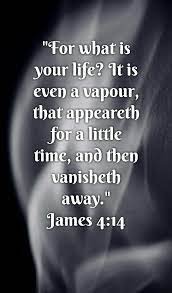
Come now, you who say, “Today or tomorrow we will go to such and such a city, and spend a year there and engage in business and make a profit.” Yet you do not know what your life will be like tomorrow. You are just a vapor that appears for a little while and then vanishes away.Instead, you ought to say, “If the Lord wills, we will live and also do this or that.
~James 4:13-15
As the sage says: “Live one day at a time, but always have your bags packed!”
Now the serpent was more crafty than any beast of the field which the Lord God had made. And he said to the woman, “Indeed, has God said, ‘You shall not eat from any tree of the garden’?” 2 The woman said to the serpent, “From the fruit of the trees of the garden we may eat; 3 but from the fruit of the tree which is in the middle of the garden, God has said, ‘You shall not eat from it or touch it, or you will die.’” 4 The serpent said to the woman, “You surely will not die! 5 For God knows that in the day you eat from it your eyes will be opened, and you will be like God, knowing good and evil.” 6 When the woman saw that the tree was good for food, and that it was a delight to the eyes, and that the tree was desirable to make one wise, she took from its fruit and ate; and she gave also to her husband with her, and he ate. 7 Then the eyes of both of them were opened, and they knew that they were naked; and they sewed fig leaves together and made themselves loin coverings.
Genesis 3:1-7
I saw Satan today….. on a YouTube video. He was posing as a progressive pastor and is, apparently, quite popular with kids who grew up in church. In this video he states, unapologetically, that God – in His Word – never says anything forbidding pre-marital sex, or sex with multiple partners while married, and He certainly never prohibited homosexual acts! The heretic went on to say that all these prohibitions were imposed, not by the Bible, but by the Purity Movement who wanted to control our bodies and our most intimate thoughts. Satan always twists God’s words!
The truth is, the sacredness of the marriage bed is proclaimed from Genesis 2 through John’s Revelation*. God’s Word says, in 1 Corinthians 6, that our bodies are temples of the Holy Spirit and that sex outside of marriage causes the Holy Spirit to by engaged in that which is unholy. In 1 Thessalonians 4, God says it’s His will for our sanctification that we abstain from pornea which is any sexual thought, word, or deed outside of marriage. God, our Maker, knows that sex is the access point for the corruption of our walk with Him. Satan, through this progressive preacher, is not trying to persuade young Christians to cheat in school or even to try drugs, he’s going right at the only sin that we can commit against our own body (1 Cor 6:17).
I don’t want to make the mistake that the purity writers made of holding virginity up as a “god” or as the surest route to happiness, but I don’t want to overlook the clear teaching of Scripture. You want to have a close walk with God? Put away ALL sexual immorality! God’s plan hasn’t changed. One man, one woman for as long as both are alive (Matt 19:3-9). If your “felt” needs (temptations) are other than conformity to God’s standard then, my friend, you share something in common with ALL of humanity. Jesus died to save us from sin, not that we should walk in it!
Pray for me, as I pray for you, and be on guard against the Roaring Lion!
Pastor Scott
*“because His judgments are true and righteous; for He has judged the great harlot who was corrupting the earth with her immorality, and He has avenged the blood of His bond-servants on her.”
As I was reprocessing last Sunday’s sermon on 1 Peter 4:7-11 (Peter’s instructions to the church to pray, love, host, and serve because the last days are upon us), my mind was drawn to a verse from Daniel, Chapter 1. Israel’s Cadet (future officers) Class was brought to Nebuchadnezzer’s palace and enrolled in a program to make them good servants of Babylon. As part of the program they were to eat like the nobles, food that YHWH had forbidden. It was undoubtedly a high pressure situation and a HUGE temptation to “go along.” But verse 8 sets the course for Daniel and his friend’s lives. “Daniel purposed in his heart that he would not defile himself.” My guess is that had Daniel waited to make that decision a year into his training, it might have been much harder to implement!
How does this apply to Peter’s “last days” pleas? Here in the states life is still pretty chill. Yes, we can see the writing on the wall, but it’s been up there since, at least, the 60’s and we’re doing fine. A fiery trial, however, could easily be right around the corner. “Purposing” to pray, love, host, and serve while our house is on fire may be too much for anyone. Get in the habit now! Individually, we need to choose now to each be the church we want around us in the fire!
The following isn’t an end-of days (1 Peter 4:7) kind of illustration, but Schuller does tell a good story about the wrong time to make decisions!
I remember one winter my dad needed firewood, and he found a dead tree and sawed it down. In the spring, to his dismay, new shoots sprouted around the trunk. He said, “I thought sure it was dead. The leaves had all dropped in the wintertime. It was so cold that twigs snapped as if there were no life left in the old tree. But now I see that there was still life at the taproot.” He looked at me and said, “Bob, don’t forget this important lesson. Never cut a tree down in the wintertime. Never make a negative decision in the low time. Never make your most important decisions when you are in your worst mood. Wait. Be patient. The storm will pass. The spring will come.”
Robert H. Schuller, Tough Times Never Last, But Tough People Do!, Thomas Nelson.







 Grace Notes