Resolved 2024 – 12.29.23

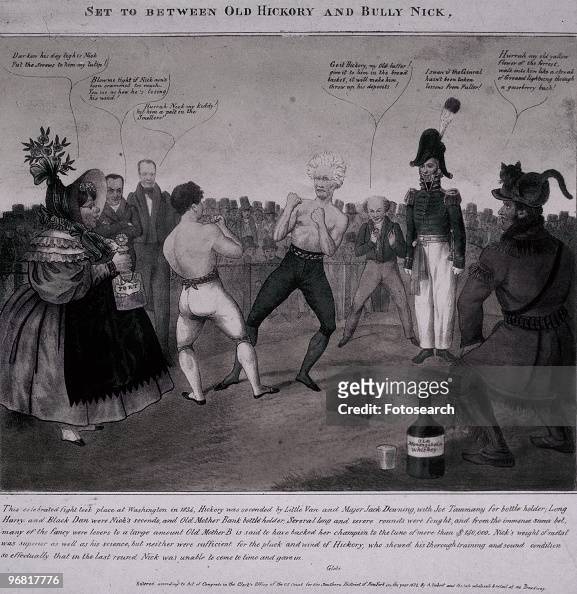
Cartoon satire on the conflict between Andrew Jackson and Nicholas Biddle over the future of the bank of the United States, circa 1832. (Photo by Fotosearch/Getty Images).

Somewhere in my “clippings file” I have a story about opposition research on Andrew Jackson (7th U.S. president; born in the Carolinas before the Revolutionary war) as he was leaving the army and entering politics.  According to the clipping a reporter went to his hometown and tracked down some childhood friends.  The reporter asked why they thought Andy had been so successful.  Was he smarter or stronger than the other boys in town?  

“No” they said, “He just wouldn’t stay throwed.”  The reporter asked for clarification.

The boys, now men, explained “When we wrestled, it was always for two out of three throws.  But Andy just wouldn’t stay down!  You could throw him 3 or even 4 times and he’d get up again and eventually throw you.  That’s our Andy, he just wouldn’t stay throwed!”

What, you may be asking, does that have to do with resolutions?  Whether I resolve to read my Bible all the way through this year, love my wife better this year, or take better care of my health this year I will get throwed.  

  • I will end up taking a phone call rather than finishing my quiet time some morning 
  • I will snap at my wife because I’m a million miles away in my mind
  • I will skip my walk because it’s cold and wet outside
    • Resolved. I will not stay throwed!

Happy New Year!

Pastor Scott

Away in a Manger – December 22, 2023

I went looking for a picture of a middle-eastern manger; one made of stone, not wood like we’d find here in the wetter West.  My search for a picture led me to an article written by a guy from a different faith tradition about his trip to Bethlhem.  Even though some of his terminology is different and certainly his side panels are not something we’re used to seeing, if you read the whole piece he makes a fabulous point that we all need to be reminded of – every year!   

Merry Christmas!

Pastor Scott

The King Came – 12.15.23

We talk a lot about how the world stage seems to setting itself up for the Antichrist. The political and cultural changes we are observing have caused a considerable amount of hand-wringing in certain circles. Yet, if we read the end of THE book, we realize we aren’t the ones who ought to be wringing our hands! The Lion of Judah, Is OUR Lion of Judah. Amen? 

As we celebrate the birth of our Savior in 10 days, lets not forget that the One who took away our sine by shedding His own blood, is coming back again to judge those who have rejected His grace.

Pastor Scott

Dealing with Hurt – 12.08.23

We have a shredder; one at home and a really big one here at church.  You need one.  It’s great to protect your identity!  It’s also great for shredding illegitimate charges.  Bills that you have already paid.  Charges that are duplicate.   It’s really irritating when a corporation or a municipality tries to collect a debt that has already been taken care of.  Has that ever happened to you?  No?  I would wager to guess it has.

We sometimes fail to recognize that anything we hold against anyone is considered a debt they owe us.  If we “forgive” someone (even “just” vertically) and are continually being bugged by the bill collector, I humbly suggest that we haven’t yet really focused on what occurred.  If we forgave them we released that debt; tore it up, covered it up with Jesus’ blood and grace.  So if it comes back to us, it’s just like an “overdue” bill that I know I’ve paid.  It should go into the shredder and or, even better, into the kindling box by the fireplace, and never get another thought!   

“Scott, that’s easy for you to say; but you don’t understand how badly he/she/they hurt me!!!”  

“You are right, I don’t, but I know a Guy 🕇”  

The Hebrew word nasa and the Greek word aphiemi both literally mean “to release” or “let go” and are both translated “forgive.”  The other Hebrew (Old Testament) word most often translated “forgive” is Kipper or atone (cover with blood).  The other Greek (New Testament) word is Charizomai (“grace” as a verb).

Dictionary of New Testament Theology

I did neglect one word that is used in the OT, the word is “Azazel.”  It’s one of two goats used on the Day of Atonement.  The first is sacrificed.  The second, the “scapegoat”, is sent out into the wilderness after the sins of all the people are confessed onto its head (Leviticus 16:21-22).  The wilderness of course would make a goat disappear completely, just like the sins of the people (Matthew 27:11-26; cf. Hebrews 13:12-13).

Pray for me, as I pray for you,

Pastor Scott

The King Is Coming! December 1, 2023

stairway to heaven

The people who walk in darkness
Will see a great light;
Those who live in a dark land,
The light will shine on them.
You shall multiply the nation,
You shall increase their gladness;
They will be glad in Your presence
As with the gladness of harvest,
As men rejoice when they divide the spoil.
 For You shall break the yoke of their burden and the staff on their shoulders,
The rod of their oppressor, as at the battle of Midian.
 For every boot of the booted warrior in the battle tumult,
And cloak rolled in blood, will be for burning, fuel for the fire.
For a child will be born to us, a son will be given to us;
And the government will rest on His shoulders;
And His name will be called Wonderful Counselor, Mighty God,
Eternal Father, Prince of Peace.
There will be no end to the increase of His government or of peace,
On the throne of David and over his kingdom,
To establish it and to uphold it with justice and righteousness
From then on and forevermore.
The zeal of the Lord of hosts will accomplish this.

It’s cool out so wear your cool jacket! – 11.17.23

Below is an article explaining “literal” meaning vs. “popular” meaning.  I have been, fruitlessly, trying to defend the literal (denotative) meaning of the word “relational” and this blog is serving notice of my surrender. 

When we are Born Again (“Justified,” “adopted,” “sealed by the Holy Spirit onto the day of Redemption,” etc) we become children of God.  That is our Relationship with Him.   He is our Father, we are His kids.  We are powerless to change that “Relationship!”

We, however, can grow distant. As we step out of the light, as we walk outside of Fellowship we grow distant from our Father.  He is still our Father!  But we are out of “Fellowship” and we need to return to the light (1 John 1:9).  

In my effort to distinguish between the one time forgiveness we experience at the Cross (Ephesians 1:7) and the forgiveness we need to restore Fellowship (1 John 1:9); I used the words “relational forgiveness” vs. “fellowship forgiveness;” but given the connotation of relational, I (and, perhaps, you) found it confusing.   

So upon the recommendation of an Elder, I am going to refer to our permanent forgiveness as “forensic” and our daily debts or tresspasses as “temporal” – at least those two words don’t have overlap; yet.  🙂

Pastor Scott 

Recognizing the denotative and connotative meanings of words can help ensure that you understand exactly what an author is trying to say as well as ensuring that you are saying exactly what you want to say in your own writing.

The denotative meaning is the literal or formal meaning of a word. For instance, the term dog denotes an animal with fur, four legs, and a tail. But when someone calls someone else a dog, this does not mean that the person has four legs and is furry. Instead, the connotative meaning of the word is used, which conjures up ideas based on how it is used in pop-culture or in an overall metaphorical sense. Connotative meanings can be either positive or negative; dog can be a derogatory term meant as an insult, or it can used in a light-hearted way meaning friend.

Unless an author clearly defines how a word or complex term is being used in a reading, both denotative and connotative meanings should be considered. In your own writing, both are acceptable to use, but you must be aware that people may interpret the word differently than you intended if you choose a word that can be read in more than one way.

Because of subtle differences in both denotative and connotative meaning, be very careful when you use a thesaurus as you write. Some of the words listed as synonyms or antonyms cannot be switched out equally. Be sure to use a dictionary to look up the meaning of a word if you are uncertain of what it means in the context of the sentence.

Below are some examples of denotative and connotative meanings of words.

WordDenotative MeaningConnotative Meaning
Hothigh temperature; heatedextremely attractive; angry
Coollow temperaturepopular; acceptable
Deadabsent of life and/or animationunusually quiet setting
Chickyoung birdgirl or woman
Crazyinsane; mentally unstablewild and exciting
Sharkpredatory fishhighly skilled
From Website “WordGeeks”

Bruised for our Iniquities – November 10, 2023

This is the story I read before communion on Sunday (11/5); I cannot find the original, I mostly am finding close variations that are imbedded in published sermons and Christmas/Easter publications.  Might be worth printing and saving for a family dinner or devotion. ~Pastor Scott

“Years ago there was a little one-room schoolhouse in the mountains of Virginia where the boys were so rough that no teacher had been able to handle them.

“A young, inexperienced teacher applied, and the old director scanned him and asked: ‘Young fellow, do you know that you are asking for an awful beating? Every teacher that we have had here for years has had to take one.’

“‘I will risk it,’ he replied.

“The first day of school came, and the teacher appeared for duty. One big fellow named Tom whispered: ‘I won’t need any help with this one. I can lick him myself.’

“The teacher said, ‘Good morning, boys, we have come to conduct school.’ They yelled and made fun at the top of their voices. ‘Now, I want a good school, but I confess that I do not know how unless you help me. Suppose we have a few rules. You tell me, and I will write them on the blackboard.’

“One fellow yelled, ‘No stealing!’ Another yelled, ‘On time.’ Finally, ten rules appeared on the blackboard.

“‘Now,’ said the teacher, ‘a law is not good unless there is a penalty attached. What shall we do with one who breaks the rules?’

“‘Beat him across the back ten times without his coat on,’ came the response from the class.

“‘That is pretty severe, boys. Are you sure that you are ready to stand by it?’ Another yelled, ‘I second the motion,’ and the teacher said, ‘All right, we will live by them! Class, come to order!’

“In a day or so, ‘Big Tom’ found that his lunch had been stolen. The thief was located—a little hungry fellow, about ten years old. ‘We have found the thief and he must be punished according to your rule—ten stripes across the back. Jim, come up here!’ the teacher said.

“The little fellow, trembling, came up slowly with a big coat fastened up to his neck and pleaded, ‘Teacher, you can lick me as hard as you like, but please, don’t take my coat off!’

“‘Take your coat off,’ the teacher said. ‘You helped make the rules!’

“‘Oh, teacher, don’t make me!’ He began to unbutton, and what did the teacher see? The boy had no shirt on, and revealed a bony little crippled body.

“‘How can I whip this child?’ he thought. ‘But I must, I must do something if I am to keep this school.’ Everything was quiet as death.

“‘How come you aren’t wearing a shirt, Jim?’

“He replied, ‘My father died and my mother is very poor. I have only one shirt and she is washing it today, and I wore my brother’s big coat to keep me warm.’

“The teacher, with rod in hand, hesitated. Just then ‘Big Tom’ jumped to his feet and said, ‘Teacher, if you don’t object, I will take Jim’s licking for him.’

“‘Very well, there is a certain law that one can become a substitute for another. Are you all agreed?’

“Off came Tom’s coat, and after five strokes the rod broke! The teacher bowed his head in his hands and thought, ‘How can I finish this awful task?’ Then he heard the class sobbing, and what did he see? Little Jim had reached up and caught Tom with both arms around his neck. ‘Tom, I’m sorry that I stole your lunch, but I was awful hungry. Tom, I will love you till I die for taking my licking for me! Yes, I will love you forever!’”

To lift a phrase from this simple story, Jesus, my Redeemer, has taken “my licking for me” and yours for you.

Declared the prophet Isaiah:

“Surely he hath borne our griefs, and carried our sorrows: …

“… He was wounded for our transgressions, he was bruised for our iniquities: the chastisement of our peace was upon him; and with his stripes we are healed” (Isa. 53:4–5).

Give the Ball to Larry – 11/3/23

Whether you are a basketball fan or not, you are probably familiar with the name Larry Bird – the former basketball great of the Boston Celtics.


During a retirement party for Larry Bird in Boston Garden, former Celtics coach K.C. Jones told of diagramming a play on the sidelines, only to have Bird dismiss it, saying: “Get the ball to me and get everyone out of my way.”

Jones responded, “I’m the coach, and I will call the plays.”  Then Jones turned to the other players and said, “Get the ball to Larry, and get out of his way.”

That should be the church’s message – Give the ball to Jesus, put your life in his hands, and get out of the way.  Too often, I’m afraid, we try to hog the ball.  🙂

Pastor Scott

P.S. Only the last sentences are “mine” the rest came out of a book entitled “1001 Humorous Illustrations”

Applied Pacifism – Oct 27, 2023

In Matthew 5, in addition to the Beatitudes, Jesus uses six antitheses to talk about the law in an internalized way.  This past Sunday (10/22) we looked at the 4th and the 5th during the Sunday Sunday sermon; His discussion about oaths and His discussion about retaliation.  I concluded that God calls us to live honest lives of service to others, and I stand by that, but I regret that I left some things unsaid regarding turning the other cheek and its relation to self-defense.

Levitical law* puts a limit on how much a plaintiff can ask for (or take) in a civil case.  “Take” because the Jews in Jesus’ time didn’t have access to courts and the temptation was to take “justice” into their own hands.  Jesus famously said, “You have heard it said, ‘An eye for an eye and a tooth for a tooth, But I say to you, do not resist an evil person; but whoever slaps you on your right cheek, turn the other to him also..’”  In a right-handed world, a slap on the right cheek is most likely a back-hand, meaning an insult more than a deadly attack.  So not resisting is putting up with the sting of humiliation rather than the risk of life (as I made it out to be from the pulpit).  On Sunday I was envisioning a life or death encounter and shared one third of my own personal conviction (Romans 14:5b).

  1. If someone is threatening my life and I have the ability to “return fire”, it occurs to me that even though I have the right to self defense in the USA and even though the Bible doesn’t prohibit self-defense, both the thrust of the Sermon on the Mount and the logic that I have a guaranteed home in heaven and my enemy might not, is enough to stay my hand.
  2. If someone is attacking my family it is MY job to stop them; up to and including deadly force, if absolutely needed.
  3. I believe that law enforcement and the military were ordained by God and carry “the sword” to avenge evil  (Romans 13:1-7).  It’s my conviction that a Christian ought to be able to serve in either. 

Conclusion:  “Turn the other cheek” could justifiably apply only to insults and those only of a spiritual nature, all the way through to conscientious objection to all forms of violence.   My personal stand is simply against personal self-defense and that’s not a stand that really gets tested.  I think in my world and yours, “turning the other cheek”  is more about not responding in, or holding bitterness against, those who step on our feelings!  That said, convictions about home defense and about carrying arms in public service ought to be based on Scripture and personal conviction.  Just like eating meat from a pagan market, or which holidays you honor, your conviction is not my concern as long as you are standing rightly before God and mine isn’t yours as long as I’m also square with God!   “Whatever is not from faith, is sin” (Romans 14:23b).

Pastor Scott 

*Leviticus 24:19-21 NASB 1995

If a man injures his neighbor, just as he has done, so it shall be done to him:  fracture for fracture, eye for eye, tooth for tooth; just as he has injured a man, so it shall be inflicted on him.  Thus the one who kills an animal shall make it good, but the one who kills a man shall be put to death.”