Next Month’s Bread – August 30, 2024

Sometimes you run across a quotation that hits you right between the eyes…  Pastor Scott

“A more Christian attitude, which can be attained at any age, is that of leaving futurity in God’s hands. We may as well, for God will certainly retain it whether we leave it to him or not. Never, in peace or war, commit your virtue or your happiness to the future.

Happy work is best done by the man who takes his long-term plans somewhat lightly and works from moment to moment ‘as to the Lord’. It is only our daily bread that we are encouraged to ask for. The present is the only time in which any duty can be done or any grace received.”

CS Lewis, The Weight Of Glory

“‘Therefore I tell you, do not be anxious about your life, what you will eat or what you will drink, nor about your body, what you will put on. Is not life more than food, and the body more than clothing?

Look at the birds of the air: they neither sow nor reap nor gather into barns, and yet your heavenly Father feeds them. Are you not of more value than they? And which of you by being anxious can add a single hour to his span of life? And why are you anxious about clothing? Consider the lilies of the field, how they grow: they neither toil nor spin, yet I tell you, even Solomon in all his glory was not arrayed like one of these.

But if God so clothes the grass of the field, which today is alive and tomorrow is thrown into the oven, will he not much more clothe you, O you of little faith? Therefore do not be anxious, saying, ‘What shall we eat?’ or ‘What shall we drink?’ or ‘What shall we wear?’ For the Gentiles seek after all these things, and your heavenly Father knows that you need them all. But seek first the kingdom of God and his righteousness, and all these things will be added to you.

‘Therefore do not be anxious about tomorrow, for tomorrow will be anxious for itself. Sufficient for the day is its own trouble.’”

Matthew 6:25-34

The Shield-wall of Faith – Aug 23, 2024

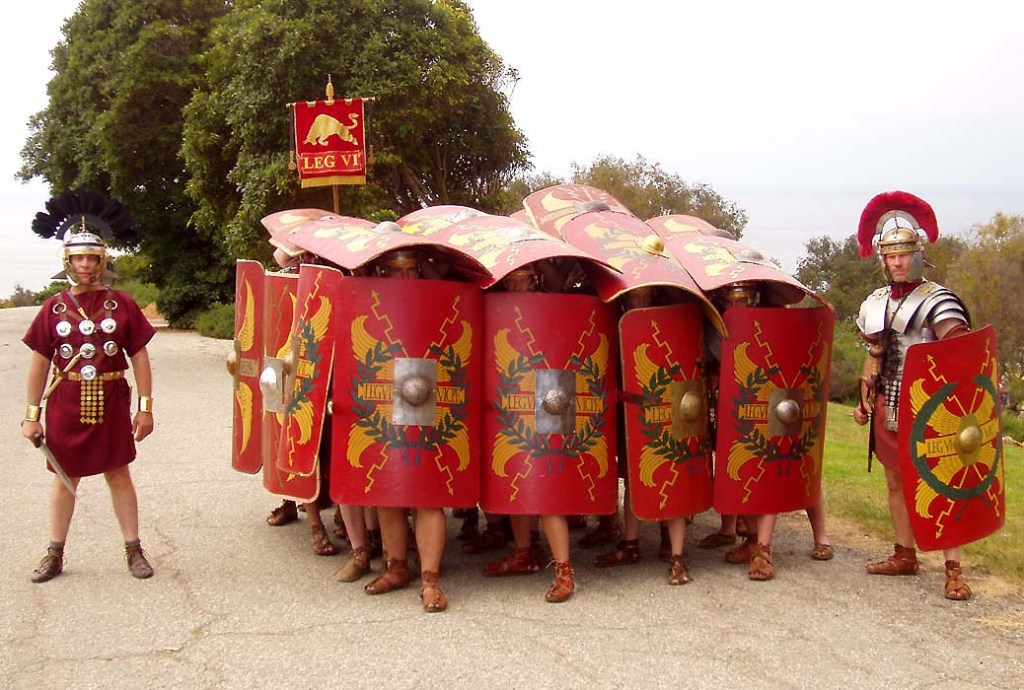
A Roman Shield Wall Reenactment

Our elder emeritus and long-time Bible teacher, Dr. Biery, often shares a story of covering a brother’s weakness.  I was reminded of that when I came across this illustration of 1 Corinthians 13:7    ”[love] …bears all things, believes all things, hopes all things, endures all things.”

In a Leadership profile of pastor and author Stu Weber, Dave Goetz writes:

Growing up, Weber developed a temper, which blossomed in high school and college. “And then I went into the military,” Weber said, “which doesn’t do a lot to curb your temper and develop relational skills.  “Early in his ministry, he stopped playing church-league basketball altogether; his temper kept flaring, embarrassing himself and the church. A decade passed. “I hadn’t had a flash of temper for years,” Weber said. “I thought, the Lord has been good. I’m actually growing.”

Then his oldest son made the high school varsity basketball squad. “I began living my life again through my son.” Weber terrorized the referees. On one occasion, seated in the second row, Weber wound up on the floor level, with no recollection of how he got there. He received nasty letters from church members, who, he says now, “were absolutely right on.”

But then he got another note: “Stu, I know your heart. I know that’s not you. I know that you want to live for Christ and his reputation. And I know that’s not happened at these ballgames. If it would be helpful to you, I’d come to the games with you and sit beside you.”

It was from one of his accountability partners.

“Steve saved my life,” Weber said. “It was an invitation, a gracious extension of truth. He assumed the best and believed in me.”

When we love others, we believe in and hope the best for them even when they fail.

John defines “love of the world” as the 1) the lust of the flesh; 2) the lust of the eyes, and 3) the boastful pride of life.  I’ve always believed that an aspect of the pride of life is not just in boasting but in wishing the worst on others (ie. “rejoicing in unrighteousness – 1 Cor. 13:6a).   As we seek to love each other as Christ loved us, part of that love is to help each other across the finish line NOT to secretly hope someone fails – that’s not love that’s the boastful pride of life!  ~ Pastor Scott

Christian Preppers  – August 16, 2024

In the first of Paul’s pastoral epistles he warns Timothy of a coming apostasy that will creep into the church* and then he says, to Timothy:

“In pointing out these things to the brethren, you will be a good servant of Christ Jesus, constantly nourished on the words of the faith and of the sound doctrine which you have been following.  But have nothing to do with worldly fables fit only for old women. On the other hand, discipline yourself for the purpose of godliness;  for bodily discipline is only of little profit, but godliness is profitable for all things, since it holds promise for the present life and also for the life to come.  It is a trustworthy statement deserving full acceptance.  For it is for this we labor and strive, because we have fixed our hope on the living God, who is the Savior of all men, especially of believers.” – 1 Timothy 4:6-10

It’s instructive to me that despite the collapse of the church and/or state that Paul is prophesying, his word to us is, “keep on keeping on.”  Ignore the stories (Gossip? Politics? Conspiracy theories?) and keep up your discipline.  Not to earn the salvation that Jesus bought for us, but so as to be godly enough for Him to use as we fix our hope, not on an election or a human fix, but on the living God!

Paul’s mention of athletic discipline reminds us that if we don’t use it, we will lose it!  So yes we should be taking care of our bodies but even more importantly we should be taking care of our souls!  

Richard Foster’s Twelve Disciplines** (see below) are all drawn from Scripture, but I don’t see it as a checklist (we should feel free to add, subtract and recombine).  It’s good to be reminded there are things we can do everyday that will strengthen our hearts toward God.

  • Inward disciplines: meditation, prayer, fasting, and study.
  • Outward disciplines: simplicity, solitude, submission, and service.
  • Corporate disciplines: confession, worship, guidance, and celebration. 

Something to think about!

Pastor Scott

*I believe the warnings in 1 Timothy have been a consistent plague on the Church down through the ages.  God purges and the process starts again, but one of these times it will be the last time and it sure feels like that could be soon!

**I have to give Foster credit for this biblical list.  However, I also have a “check in my spirit.”  Galatians 3 warns us how the Galatian believers thought their sanctification was dependent on their hard work and Paul said, no, that God was the One through whom we would be made perfect.  Foster’s book gives an alternative impression.

Communion – 08.09.24

It has been my privilege to sit in the presence of a number of homebound saints over the years who still had a lot of insights to share.  One of those was Darline Metzker who continued to write for GotQuestions.org for many years after she surrendered her driver’s license.  On my visits with her, we would often discuss articles she was writing.  I remember one on communion (which also happens to be a current query).  I can’t be sure this is THE one she wrote, but given that she and I worked on a communion article, I think it’s appropriate to republish GotQuestions answer to the question of why we think we are “right” on the issue of communion. ~Pastor Scott

Why is there so much disagreement about holy communion?

Holy communion or the Lord’s Supper (also known in some churches as the Lord’s Table or the Eucharist) is a source of significant disagreement within the church as a whole. What’s agreed upon is found clearly in Scripture: communion was instituted by Jesus during His last supper with His disciples. During that time, He served them bread and “the cup.” He told them that these elements were His body and blood (Matthew 26:26–28; Mark 14:22–24). He also instructed them to repeat the ceremony in remembrance of Him (Luke 22:19).

Disagreements over holy communion stem from many questions: Was Jesus speaking of His body and blood figuratively or literally, or were His words a mystical combination of the figurative and literal? How often is the church to observe communion? Is the Eucharist a means of grace or simply a memorial? What was in the cup—fermented wine or unfermented grape juice?

Because Jesus did not give specific, step-by-step instructions regarding the ritual, naturally, there is some conflict about the hows and wheres and whens, and what exactly the bread and wine represent. There are arguments about whether or not the elements actually become the blood and body of Christ (the Catholic doctrine of transubstantiation), whether they somehow contain His Spirit (Luther’s doctrine of consubstantiation), or whether the wine and bread are simply symbols of His body and blood. There are differing opinions about the liturgy that should be spoken and whether or not confession should be part of the ritual. Denominations differ on the frequency of the communion, how it should be performed, and by whom.

There are four biblical accounts of Jesus’ last supper with His disciples, three in the Synoptic Gospels and one in 1 Corinthians 11:23–34. When we look at these accounts in combination, we know the following:

1. During the Passover meal, Jesus blessed, broke, and offered bread to His disciples, saying, “Take eat, this is my body, which is given for you. Do this in remembrance of me.”

2. He also passed around a cup, telling them to divide it among them: “This cup that is poured out for you is the new covenant in my blood, poured out for many, for the forgiveness of sins.” He also instructed all of them to drink it.

3. It was during this last meal that Jesus mentions that one of His disciples would betray Him.

4. Jesus says He will not drink of the fruit of the vine again until He drinks it anew with His followers in the Father’s kingdom.

As He instituted the Lord’s Supper, Jesus was focused on the spiritual relationship between Himself and His disciples. He did not provide particulars of how or when or where or by whom the elements should be served, and, therefore, different churches have some freedom to decide those details for themselves. For example, whether a church observes communion once a week or once a month is not really important.

However, other disagreements over communion are theologically significant. For example, if partaking of the Lord’s Table is necessary in order to receive grace, then grace is not really free and must be earned by deeds we perform, in contradiction of Titus 3:5. And, if the bread is actually the body of Christ, then the Lord is being sacrificed again and again, in contradiction of Romans 6:9–10. These matters are significant enough to have divided the church through the years and actually became an issue of contention during the Protestant Reformation.

Understanding that we are saved by grace, through faith, apart from works (Ephesians 2:8–9) and considering Jesus’ words concerning the elements of communion to be figurative, we focus on the beauty of the new covenant (Matthew 26:28) brought into effect by Jesus’ own blood. We remember His sacrifice for us as often as we partake of the Lord’s Table (Luke 22:19). And we look forward to once again sharing the cup with Christ in the kingdom of God (Matthew 26:29; Mark 14:25; Luke 22:18).

The Opening Ceremonies – Aug 2, 2024

Kelly and I missed the opening ceremonies, not on purpose, time just got away from us, but we sure heard about it.  Since it’s been a week, I don’t need to rehash it all here, but I do think I need to point out that two different Christian stances I see on the internet may both be biblical!

We all saw images of a fleshly display that resembled: 

The Last Supper as painted by DaVinci; or a feast of Dionysus (Baacus) the god of wine,  

said later to have just been an artsy protest against the ruling about transgender athletes.  

The first news stories and social media posts I saw from both, my friends and from big Christian names, were all shining the light of exposure, pointing out the disgrace of such a shameful display and mockery. The focus was on the deeds as was Paul’s in Ephesians 5:

Let no one deceive you with empty words, for because of these things the wrath of God comes upon the sons of disobedience.  Therefore do not be partakers with them;  for you were formerly darkness, but now you are Light in the Lord; walk as children of Light  (for the fruit of the Light consists in all goodness and righteousness and truth),  trying to learn what is pleasing to the Lord.  Do not participate in the unfruitful deeds of darkness, but instead even expose them;  for it is disgraceful even to speak of the things which are done by them in secret.  But all things become visible when they are exposed by the light, for everything that becomes visible is light.  For this reason it says, “Awake, sleeper, And arise from the dead, And Christ will shine on you.”  (Ephesians 5:6-14)

Shortly after that round of finger shaking there was another round of news stories and posts from both other friends and other big Christian names sort scolding those “prophetic voices” and pointing out that Jesus ate with people like that, Jesus came to redeem people like that, Jesus died for people like that:

  “When the scribes of the Pharisees saw that He was eating with the sinners and tax collectors, they said to His disciples, “Why is He eating and drinking with tax collectors and sinners?”  And hearing this, Jesus *said to them, “It is not those who are healthy who need a physician, but those who are sick; I did not come to call the righteous, but sinners.” (Mark 2:16-17)“Come to Me, all who are weary and heavy-laden, and I will give you rest. 29 Take My yoke upon you and learn from Me, for I am gentle and humble in heart, and you will find rest for your souls.  For My yoke is easy and My burden is light.”  (Matthew 11:28-30)

How can both be right?  Well the deeds, whatever they were intending, were shameful and certainly not something we should be condoning.  At the same time the people involved are each image bearers and need our love and need our Savior.  So, both things can be true at once.  Tone matters, but that’s always hard because the mercy leaning folks will always think the prophet’s tone is too harsh and the prophets will always hear mercy’s voice as weak, but God speaks with both voices and we need to respect that He gifted His church with both types of people!  Thank God that His mercy and grace is deep and wide enough to engulf all of our different and very strong feelings! 🙂

Pastor Scott

P.S. Paul reminds us in a different book that it’s God’s job to judge the world; we need to focus on keeping our own house clean!

I wrote you in my letter not to associate with immoral people;  I did not at all mean with the immoral people of this world, or with the covetous and swindlers, or with idolaters, for then you would have to go out of the world.  But actually, I wrote to you not to associate with any so-called brother if he is an immoral person, or covetous, or an idolater, or a reviler, or a drunkard, or a swindler—not even to eat with such a one.  For what have I to do with judging outsiders? Do you not judge those who are within the church?  But those who are outside, God judges. Remove the wicked man from among yourselves.  (1 Corinthians 5:9-13)